




Perhaps his gaping absence of leadership is what makes President John Evans Atta-Mills, of the so-called National Democratic Congress (NDC), stand out among the cast of Ghanaian citizens who have held the title of prime minister, president and/or head-of-state. And once again, needless to say, his glaring lack of any remarkable leadership skills came embarrassingly through the speech which the former University of Ghana's associate professor of law gave to climax activities marking the centenary celebration of the birthday of our country's first Leader of Government Business, Prime Minister, President and Life-President, Mr. Kwame Nkrumah.
You see, I am no stickler for such vacuous unearned encomiums as “Doctor,” “Osagyefo” and “Kantamanto,” and so you shall not, henceforth, be likely to read such largely decorative and ego-massaging honorifics in any of my writings associated with the man, either directly or thematically.
Suffice it to say, however, that what I particularly found to be unpardonably defective about his Nkrumah-colloquium speech is the fact that not much thought appears to have been invested in the composition of the same. Else, for instance, having laudably highlighted “the critical role [that] Dr. Nkrumah played in the struggle to launch [Ghana] onto the pedestal of nationhood,” a more honest speech-maker would also have listed a few of what may aptly be termed as the “neo-pioneers” who equally significantly contributed to the rapid onward movement of Ghana's liberation struggle.
And on the foregoing score, I am not just alluding to the other five members of the legendary “Big Six,” but also vanguard nationalists like Mr. George Ekem Fergusson, Dr. J. E. K. Aggrey, Mr. Kuntu-Blankson, Mr. George Alfred (Paa) Grant, Mr. Ephraim Casely-Hayford, Mr. Awoonor-Renner, Mr. John Mensah-Sarbah and Mr. Komla Gbedemah, among quite a remarkable roll-call of others, of course.
For it goes without saying that one cannot effectively, logically and honestly talk about the “critical role” of any politician and/or statesman, without also dialectically suggesting either the equally significant or complementary role(s) of the discursive subject's contemporaries and associates. For those who really want to know partly why I have become a passionate Danquah-Busia-Dombo partisan in recent years, some of the answer clearly inheres in the glaringly “unscientific” cultic fanaticism of Ghanaian citizens and leaders like President John Evans Atta-Mills. The other part of the story, perforce, inheres in the imperative need for well-meaning and levelheaded Ghanaian scholars, historians and intellectuals to tell a comprehensive and more realistic story about the making of modern Ghana.
Not surprisingly, in his Nkrumah-colloquium speech, President Mills slyly attempted to do what even “Kantamanto” himself had not dared to do even at the height of his political supremacy over both the country, at large, and especially his inveterate opponent, Dr. Joseph (Kwame Kyeretwie) Boakye-Danquah. On the latter score, this is what Tarkwa-Atta had to say: “It is incumbent on this generation to reel back into time and move the Continent forward beyond the point WHERE THE DOYENS OF THE LIBERATION STRUGGLE BREASTED THE TAPE” (See “Speech: Mills' Address At The Nkrumah Colloquium” MyJoyOnline.com 5/25/10).
I don't know what the Senior Young Pioneer acolyte thought he was doing by clearly attempting to shamelessly and sacrilegiously strip the undisputed Doyen of Gold Coast and Ghanaian politics of a title deservingly bestowed by the Watson Commission whose report, far more than the activity of any single individual, paved the way for Britain's granting of sovereignty status to Ghana on March 6, 1957. Anyway, between the purportedly “unsurpassed [Nkrumaist vision] nurturing and forming the life and spirit of our nation,” is the incontrovertible Danquahist spirit of African cultural consciousness and the unrelenting promotion and propagation of the democratic principles undergirding Ghana's Fourth Republic. The rest, as it were, belongs to posterity by way of a conclusive verdict.
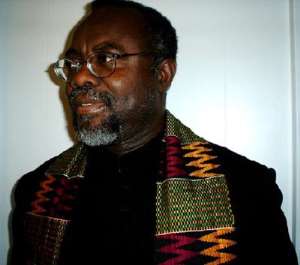
*Kwame Okoampa-Ahoofe, Jr., Ph.D., is Associate Professor of English, Journalism and Creative Writing at Nassau Community College of the State University of New York, Garden City. He is Director of The Sintim-Aboagye Center for Politics and Culture and author of “Ghanaian Politics Today” (Lulu.com, 2008). E-mail: [email protected].

 Belarus manufacturers to storm Ghana next week after President's visit
 Government to offer tax incentives for factories located outside Accra
 White House World Cup chief defends visa ban for Somali referee, Iranians
 Talensi DCE courts investors for revival of Pwalugu Tomato Factory
 Manhyia South MP says free speech under threat, cites 17 arrests in 16 months un...
 KATH doctors suspend strike after Otumfuo’s intervention
 Mahama is losing control of his government — NPP Communicator
 Health Minister’s suspension of KATH CEO technically right — Prof Beyuo
 Korle Bu Teaching Hospital conducts Ebola emergency simulation to strengthen fro...
 Abandoned newborn baby found near gutter at Agona Swedru Woaraba


