




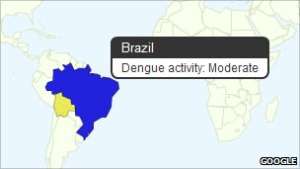
Google is using search patterns about dengue fever in an attempt to help health officials prepare for outbreaks.
It hopes to develop an early-warning system by monitoring dengue-related search terms by users in Bolivia, Brazil, India, Indonesia and Singapore.
Google said that its results are collected in real-time, whereas official data can take weeks to be analysed.
In 2009, Google used a similar approach to track the spread of flu.
"Using the dengue case count data provided by Ministries of Health and the World Health Organization, we're able to build a model that offers near real-time estimates of dengue activity based on the popularity of certain search terms," Google software engineer Vikram Sahai wrote in a blog post.
"Google Dengue Trends is automatically updated every day, thereby providing an early indicator of dengue activity."
The project was developed together with Boston's Children's Hospital and Harvard Medical School.
The methodology for the project has been shared in an article for the Public Library of Science's journal on neglected tropical diseases.
Real correlation
The tool is part of Google Correlate, a new service which connects search analysis with data collected in real life.
Correlate was created following Google's success with Flu Trends in 2009, a tool which tracked searches for flu-related searches worldwide.
Public health officials were able to use the data to distribute vaccines and treatments more effectively.
Google published a report in Nature, the highly-respected journal, and soon received attention by other researchers hoping to use the service to monitor other issues.
Correlate, launched last week, allows experts to upload their own data sets to compare against Google searches.
The software highlights when the real world data and online searches share the same patterns, such as flu outbreaks occuring at the same time as a large number of searches for "treatment for flu".
Professor Peter Sever, an expert in disease prevention from Imperial College London, said the tool could prove very useful for researchers that currently collect data using slower methods.
"It will of course be highly selective because you'll be picking out the people who are using Google, but of course year on year that's an increasing proportion of the population anyway," he said.
 Former MASLOC CEO Sedina Tamakloe returns to Ghana after extradition to serve 10...
 Tension in Birim North as angry NDC youth attempt to disrupt cooperative mining ...
 One dead, several injured in tipper truck and fuel tanker crash on Accra–Tema Mo...
 How 70-year-old building was finally demolished over fear of collapse in Osu
 Minority MPs thank Afenyo-Markin for capacity-building programme in Canada
 Ghana has everything needed to prosper yet graduates remain unemployed — Dr Step...
 June 9: Cedi sells at GHS12.50 on forex market, GHS11.85 on BoG interbank
 Stephen Amoah advocates mixed market economy to tackle rising cost of living in ...
 KMA to reintroduce enhanced ‘Samansaman’ sanitation enforcement system from July...
 Nyinahin Catholic SHS teacher seen fighting female student in viral video arrest...


