




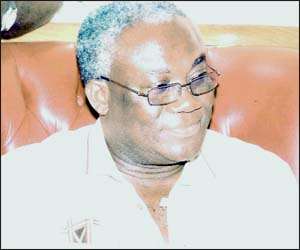
In the face of what the Steering Committee of the Ghana Trades Union Congress (TUC) considers an unbearable economic situation, the organized labour body has cautioned government that there is a limit to its tolerance level.
In a statement dubbed, 'The National Situation' and signed by the Secretary General, Kofi Asamoah, the TUC stated, “We wish to caution in this respect that there is only so much that workers can take.”
As a government professing to be motivated by social democratic principles, organized labour expects policies that are informed by “more credible and visible initiatives that protect working people and the poor and marginalized from the strains of the economy.”
The existence of challenges notwithstanding, the TUC noted that the “test of successful leadership is the ability to address effectively such challenges”.
Pointing at a rising cost of living in the country, the committee observed that “although the statistical data suggests a fall in the rate of inflation, this does not mean that the cost of living has not been rising”.
“The situation”, the committee explained, “only means that the rate at which the cost of living is rising has reduced”.
The reality for working people is that the cost of living is currently intolerable and continues to rise, the committee stated in its statement.
There might be financial challenges facing the providers of utilities, the TUC acknowledged, but added that the resolution of these should be done in a manner “that will provoke minimum social unrest”.
Continuing, organized labour noted, “The authorities should make full disclosure of the facts and figures so that collectively we can arrive at decisions that are reasonable and effective and have the support of Ghanaians.”
Increases in the cost of utilities, the TUC argued, should be graduated and seeking to insulate the working people from its effects.
The TUC also called for transparency in the country's oil find, asking that appropriate structures be put in place to ensure that the benefits from the natural resource are equitably distributed.
Given certain realities on the ground the TUC doubted the country's preparedness for managing the oil find.
“It is the considered view of Ghana TUC, that given what we all know of the crisis of organization and effective systems in all spheres of our social and economic life, and the experience to date in the other extractive industries, Ghana is clearly ill-prepared for oil production.”
The body expressed apprehension as Ghana inches towards production of the natural resource.
An inclusive and multi-partisan approach to forming committees or commissions in connection with the oil industry, should be adopted by government, the TUC demanded.
Government, it noted, is still a long way from openness, transparency, engagement with and accountability to the people of Ghana, asking that the Right to Information Bill be given adequate publicity.
By A.R. Gomda
 Titus Glover slams Mahama’s flood report directive, calls it “waste of energy an...
 We have increased posting of doctors from 12 to 100 to underserved regions in 20...
 'You had the effrontery to call me struggling lawyer, you won't come back to pow...
 Belarus manufacturers to storm Ghana next week after President's visit
 Government to offer tax incentives for factories located outside Accra
 White House World Cup chief defends visa ban for Somali referee, Iranians
 Talensi DCE courts investors for revival of Pwalugu Tomato Factory
 Manhyia South MP says free speech under threat, cites 17 arrests in 16 months un...
 Health Minister’s suspension of KATH CEO technically right — Prof Beyuo
 Korle Bu Teaching Hospital conducts Ebola emergency simulation to strengthen fro...


