




China currently prides itself as the world's most populated country, having a little over a billion people. Over the past decade, the Chinese government has tremendously helped in reducing poverty in the country. However, almost half a billion people still live below a dollar a day in China. China's economic interaction has reached a crescendo especially with African countries over the last decade. According to statistics from the Chinese Ministry of Commerce, China's direct investment in Africa reached US$552 million by June 2009. The report goes on to say that Chinese businesses signed US$22.45 billion worth of new contracts in Africa by the first half of this year. It is estimated that about one thousand Chinese enterprises have been registered to do business in Africa.
These specifics are a testimony of china's enormous and aggressiveness in terms of engagement with Africa. According to Ge Kaiyong, Executive Director of the China- Africa Business Council, China recently surpassed France to become Africa's second largest trading partner, just behind the US. China's interest in Africa dates back to the 16th century. We have seen a phenomenal investment drive from China. The excessive agility with which China's entrepreneurs invade Africa is most gratifying. However, come to think of it, what are the benefits if any at all? Some pundits and connoisseurs are asking whether China is the new colonialist of Africa.
The African experience has been very horrible after having experienced almost four to five centuries of slavery, excessive exploitation of colonialism and neo-colonialism. Africa, for a very long time has been on the receiving side of all sorts of unfair trade agreements. The human resource of this great continent till present continues to be exploited. Majority of our exports are in their raw state. And where there is the effort to add value, the advancement is still rudimentary and comes with high tariffs.
Africa's engagement with China can be both beneficial and unfavorable. At present, China's investment in infrastructure on the continent is visibly evident. Stadia and road constructions spearhead this category of China's interest in Africa. From Ghana through Botswana to South Africa, the construction of roads, stadia and dams have been undertaken by the Chinese. This goes a long way to increase the infrastructural capacity of these countries and the trickle down effect is self-explanatory. Construction workers from the various countries are employed to execute the work. The Chinese are winning more contracts especially here in Ghana and I agree that they are cost effective. On the hind side however, I am yet to be drawn to the attention of a Ghanaian who has worked with Chinese constructions and come out with his life improved than before. The most affected in this bracket are the low skilled employees. Inasmuch as we are interested in the physical development of our country for example, the human factor is also paramount. People have had concern with the quality of Chinese projects. And for China's partnership with Africa to be more beneficial, the aspect of quality should be looked at.
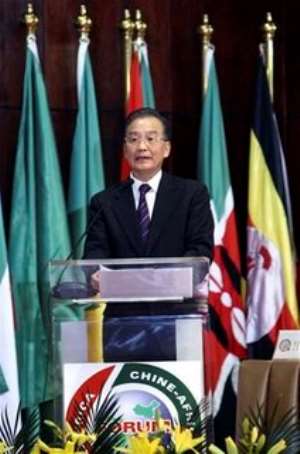
In furtherance, China has reiterated her commitment to a fruitful collaboration with Africa. This drive is communicated through China's investment in Africa's telecommunications industry, private sector and manufacturing industry. At the just ended China-Africa summit in Egypt, the Chinese Prime Minister Hu Jintao, affirmed China's position on Africa. He intimated that inflows from China to Africa will gallop by close of 2010. Chinese government scholarships to African students will also increase to 5,500. For me, there is no better time than the present to combine China's skills and expertise with African resources. It is a win-win proposition.
Ghana at the moment does not have any formal or laid down trade and investment relationship with China as echoed by Trade and Industry Minister Hannah Tetteh. However, there is no doubt that Africa and for that matter Ghana is the next frontier. This is where it is going to be happening and for young technocrats like me coming up, I will like to see a prosperous marriage between China and Africa. We will like to see among others the following; a transformation of the relationship between Africa and the rest of the world. Africa is saying that we are ready and competent enough to see through that transformation. We do not want the old rules that continue to play.
We will like to see change of rules. We would like to see a comprehensive equality of partnership. The African Union should for example, edge China to make a greater opening up. There should be a little bit of reform so that entrepreneurs from Africa would be able to access Chinese markets more easily. The same way China is able to access African markets. Of what use could Ghana's financial industry for example be to teaming unbanked Chinese market?
For me, if the quest by African leaders to alleviate poverty or better still eradicate it is to be achieved, then the target should be increasing the standards of living. The private sector is a major player in this direction. And to do that, we would like China to open up so that the private sector can go to China and invest in China and stay in China, grow from China and learn transformed technology, just like the way Chinese companies are doing in Africa. This is partnership on equal basis. For now, it is not. Let us not pretend that it is. Africa today is saying that we do not want to put new wine into the same old bottles otherwise as the Lord Jesus Christ intimated, the bottles will break up. New wine, new bottle.
Suffice it to say, the advances made by China towards investing in Africa are welcoming and could be very beneficial as compared to the West. China's policy of not meddling in Africa's internal matters is also refreshing. However, until there is a development and implementation of an umbrella investment scheme by African countries, the engagement with China in terms of an African-China trade and investment partnership will be unsustainable. This could not be put better by Citi Fm Business reporter Emmanuel Agyei as he says that if the African entrepreneurs have been identified as peculiarly discriminated against, then it would call for the intervention of respective governments and or regional institutions like the African Union by way of a dialogue with the Chinese government. Only through dialogue, can Africa benefit from any partnership with China.
Credit: Eugene Bawelle, Zenith Bank, Ghana Accra.
 One dead, fire officer hospitalised after bee attack at Quarry Site in Sokode Gb...
 Israel and Iran step back from further strikes after renewed clashes
 Patients stranded as doctors, nurses refuse to see new patients over KATH CEO su...
 Avenor Rural Bank CEO’s house destroyed by fire
 Three arrested in Winneba for illegal mining near GWL water lines
 Two pupils of Alice Elite Academy laid to rest after fatal school bus crash
 Here are areas to be affected by ECG's planned maintenance on Tuesday
 Family of civil engineer killed in alleged military shooting demands justice
 SHS teacher allegedly beats female student over unpaid hostel fees
 Blow to EU defence cooperation as France, Germany abandon joint fighter jet prog...


