




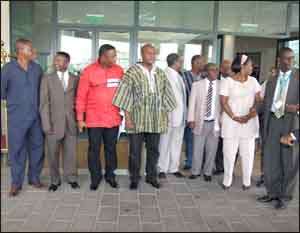
Government has stated that the inclusion of Ghana's cocoa on the list of crops that are produce by child labour by the United States Department of Labour is unfortunate and would undermine efforts at addressing the issue in the cocoa industry.
“We deem it unfair for the U.S Department of Labour, which is a major and consistent partner of Ghana, to include cocoa from Ghana on its TVRA list,” Vice President, John Dramani Mahama lamented.
The United States Department of Labour in line with its Trafficking Victims Protection Reauthorization Act (TVPRA) of 2005 has published a list of goods and crops produced by child or forced labour and human trafficking.
The TVPRA Act of 2005 mandates the U.S Bureau of International Labour Affairs to carry out additional activities to monitor and combat forced and child labor in foreign countries.
It also mandates the Bureau to develop and make available to the public, a list of goods from countries that ILAB believes are produce by forced labor or child labor in violation of international standards.
In the TVPRA list of 122 products from 58 countries believed to be produced by forced and child labor or both, the US Department of labour included cocoa, tilapia and gold from Ghana.
The countries on the list span every region of the world with cotton, sugarcane, tobacco, coffee, rice, and cocoa being the most common agricultural goods.
Speaking at the second joint meeting of stakeholders from Ghana and Cote d'Ivoire on labour practices in the production of cocoa, the Vice President said the inclusion of cocoa from Ghana on the list “is unacceptable.”
He said, “Government is therefore of the view that cocoa from Ghana should be expunged from the TVPRA List.”
Mr Mahama explained that government had put in place workable framework, including the National Programme for the Elimination of Worst Forms of Child Labour (NPECLC) to ensure that Ghana's cocoa are produced without child labour.
He noted that remediation activities in over 500 cocoa growing communities, which started in 2008, had benefitted 8000 children as part of interventions to eliminate child labour in the cocoa sector.
“That is why I am calling on all partners, especially the global chocolate players to do more to support the Ministry and the Ghana Cocoa Board to accelerate the remediation activities.
A Joint Working Group (JWG) was formed to provide strategic and action-oriented policies for Ghana, Cote d'Ivoire, key members of the global chocolate industry and civil society organizations in respect of labour practices in the cocoa sector.
The meetings of the JWG alternate between Ghana and Cote d'Ivoire.
The Government of Cote d'Ivoire hosted the 1st meeting on 30th and 31st July, 2009.
The NPECLC was set up in 2006 by the Ministry of Employment & Social Welfare in collaboration with Ministry of Finance & Economic Planning (MOFEP) and Ghana Cocoa Board to respond to international concerns about child labour in the country's cocoa sector.
It is implemented under the ILO Convention (182), which was ratified by Ghana, and the Children Act (Act 560, 1998).
By Emelia Ennin Abbey
 One dead, fire officer hospitalised after bee attack at Quarry Site in Sokode Gb...
 Israel and Iran step back from further strikes after renewed clashes
 Patients stranded as doctors, nurses refuse to see new patients over KATH CEO su...
 Avenor Rural Bank CEO’s house destroyed by fire
 Three arrested in Winneba for illegal mining near GWL water lines
 Two pupils of Alice Elite Academy laid to rest after fatal school bus crash
 Here are areas to be affected by ECG's planned maintenance on Tuesday
 Family of civil engineer killed in alleged military shooting demands justice
 SHS teacher allegedly beats female student over unpaid hostel fees
 Blow to EU defence cooperation as France, Germany abandon joint fighter jet prog...


