




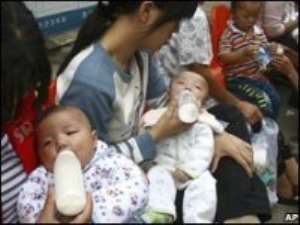
China has executed two people for their role in a scandal involving tainted milk powder that resulted in six children dying, officials have said.
More than 300,000 other infants were made ill from milk powder contaminated with melamine, an industrial chemical used to make plastics and fertiliser.
Zhang Yujun and Geng Jinping are the only people to have been executed over the scandal, court officials said.
Nineteen other people were sentenced to prison terms.
Zhang Yujun was convicted of endangering public safety by dangerous means, for selling more than 770 tonnes of the tainted milk powder from July 2007 to August 2008, the official Xinhua news agency said.
Geng Jinping, who managed a milk production centre, was convicted of supplying milk containing melamine to the now-bankrupt Sanlu Group and other dairies.
The two men were sentenced in January in Shijiazhuang, capital of Hebei, where Sanlu was based. Their appeals were rejected by the Hebei Provincial Higher People's Court in March.
Xinhua said the executions were carried out on Tuesday, but did not say where.
Tian Wenhua, the former chairwoman of Sanlu, was the highest-ranking executive charged over the scandal.
She pleaded guilty to producing and selling fake or substandard milk, charges that did not carry the death sentence, and was sentenced to life in prison in January.
Melamine is used in the making of plastics and fertilisers. When added to food products it indicates a higher apparent protein content but can cause kidney stones and kidney failure.
Milk dealers and middlemen, including Zhang and Geng, sold the milk to major dairy companies who failed to test it for its purity and nutritional value.
Sanlu had been China's largest seller of milk powder until news of the racket broke in mid-September last year, Xinhua said.
It emerged that Sanlu had known it was selling toxic milk - and allowed around 900 tonnes of it to leave its dairies before it stopped production.
The case provoked widespread public outrage in China and came after a series of similar food safety incidents, including another one of contaminated milk powder four years previously which left 13 babies dead.
It led to product recalls across the globe, and further damaged China's reputation for producing safe and reliable products, correspondents say.
In December 2008, the government ordered 22 firms implicated in the scandal to pay a total of 1.1bn yuan ($161m; £97.5m) to the hundreds of thousands of families involved.
But some of these have argued that the compensation is inadequate and appealed to the Supreme Court for compensation.
A lawyer representing parents of children affected by the tainted milk said the problem was with an inadequate regulatory system.
"It's hard to understand why these people are give such harsh punishment because, generally speaking... there is a lack of monitoring and regulation," said Li Fangping.
"I think it's the food supervision and inspection authorities that are responsible for this."
 How 70-year-old building was finally demolished over fear of collapse in Osu
 Minority MPs thank Afenyo-Markin for capacity-building programme in Canada
 Ghana has everything needed to prosper yet graduates remain unemployed — Dr Step...
 June 9: Cedi sells at GHS12.50 on forex market, GHS11.85 on BoG interbank
 Stephen Amoah advocates mixed market economy to tackle rising cost of living in ...
 Publish a clear and detailed BoG recapitalisation plan — NPP urges gov't
 Completely abandon idea of selling BoG headquarters — NPP urges gov't
 French President Macron to attend Ghana's Next Steps Conference on Reparatory Ju...
 Nyinahin Catholic SHS teacher seen fighting female student in viral video arrest...
 Trump gets a cold reception at NBA Finals game as Spurs beat Knicks


