




Empowering the Youth through Service Learning.
By Anis Haffar
Accepting the need to bring innovation and efficiencies into government structures should be a foregone conclusion. In 1999 Bill Gates sounded the way forward in his transformational bestseller “Business @ the Speed of Thought.”
In a chapter titled “Information Flow is Your Lifeblood”, he details the necessity to “Create a Paperless Office”. In another section, “Manage Knowledge to Improve Strategic Thought”, he suggests ways to “Treat IT as a Strategic Resource” and thereby “Shift People into Thinking Work”, as opposed to repetitive copying, and non-thinking work.
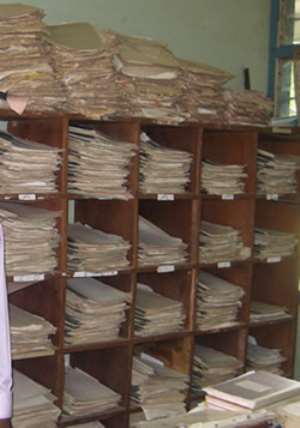
Those ideas - and the methods that enforce them - should be required reading to guide administrators, educators, and students for leadership - and especially for elected and appointed officials. For starters, it is impossible to use 19th century archaic methods of filing papers to meet 21st century demands that require huge amounts of information for storage, retrieval, processing, and planning.
It is not that pertinent ideas or solutions are lacking: cutting edge IT methods and solutions already exist in Ghana, and are used daily by competitive corporate bodies like banks and telecommunications companies. What institution – serious in its mission - would ask that you “go and come tomorrow” after a person had struggled through thick and thin to arrive?
But such stressful demands are made daily by people in government offices. It is likely that though the officers in charge intend to be dutiful, they find it hard to perform effectively without the digital tools. Worse, the blame for lack of performance is shifted unconsciously on harmless individuals now victimised to make yet another wasteful trip. Official bottlenecks clog systems in the same ways plaques clog arteries and destroy life.
The fact that a nation - or its departments - may be financially incapable to pursue the research and development (R & D) of “nanotechnology” does not mean it cannot use and benefit from the power of computer chips. Without re-inventing the wheel, the benefits of science - the scientific tools and means - are at the disposal of everyone, the poor and rich alike. Just as the tools of the Industrial Age leveraged the capacities of the human muscle, the tools of the Digital Age extends the capacities of the human mind, and increases productivity and wealth across board.
Sadly, change is seen by entrenched bureaucrats as a humongous nuisance about to explode. But whichever mode is chosen - energy or paralysis - enthusiasm or indolence - success or failure - depends on people in leadership positions.
Empowering the youth for modern challenges is imperative. For one thing, the youth are upbeat and are not as inflexible as adults; they carry less baggage; they are not afraid to try; their instincts are for purpose, and action. They need, merely, to be supported, motivated, and guided. The benefits of their participation in meaningful work, thereafter, will flow endlessly from one generation to the other.
When it comes to computers and electronic gadgetry how many adults can match the dexterity of these youngsters? The young generation everywhere are digitally motivated beyond question. It is their day, the digital age, and they need to be drawn in for the tasks that adults are so fearful of.
In my work - teaching both adults and the youth - I have on occasion had to deliberate, foremost, with the youth: that is, to go through the elements of a given curriculum with the students themselves; engage them with ideas that are feasible, and the new things that are possible to do. With conviction they articulate the objectives, and demonstrate freely to teachers the ways to achieve them. It works from the bottom up.
Frozen mindsets tend to choke progress. They tend to “infantilize” the youth for far too long, way beyond decent limits. Unwittingly, through “a self-fulfilling prophesy”, the usefulness of the youth is negated. It is assumed far too quickly that the youth are not up to important tasks; but in retrospect it may be the grown-ups who are themselves not inspired for fresh challenges.
The missing pieces are vision, objectives, planning, and implementation. J.E. Casely-Hayford (1866 – 1903) underscored “a curriculum relevant to Africa's needs and conditions” a century ago. If educational curriculum is not crafted to support the nation's progress, then of what use is it? For African nations, particularly, education may as well be 1% theory, and 99% practice. There's so much to do, and people must be connected with meaningful tasks.
The recent fire that blazed the Ministry of Foreign Affairs laid bare our vulnerability; it evoked a case study. Things had to get worse before they got better. Besides the destruction of physical property, archival and intellectual capital were lost to the fire, and they could have been prevented through digitized storage systems, and back-ups.
More than ever, it is now necessary to set up uniform IT systems and templates to digitize the files of every government office to avoid future mishaps, be they by accident, negligence, or wilful intent. Once the structures – software, equipment, and training - have been sorted out, the inputting can be done by students in the respective municipalities and districts to start the process across the length and breadth of the nation.
A Central Nervous System - a national intelligence sourced from a comprehensive data base - must be devised subsequently to tie the various government systems together for ease of cataloguing, protection, storage, access, planning, etc. That is, integration among the various departments requires a blueprint architecture instructing each department (each cell) on how to function, and stay in concert with all others.
Such digital systems must be designed ideally by the IT departments of the nation's universities; and made accessible for each of the 10 regions. Our high schools and university students can be trained quickly and easily for the task of inputting data, and scanning documents. The idea is to complement the courage of the youth with the astuteness of mature minds. That will put paid to bureaucratic speeches about “God given talents” and “solving developmental problems” that dissolve into thin air, and never materialize.
“Service Learning” should be a part of every school's culture to move Ghana forward. It connects academic curriculum directly with the nation's development agenda. In other words, What is studied in schools must be practically, and visibly related to Ghana's progress from day one. It grows the learners to be functionally literate and useful, as they apply content knowledge in real-life contexts. It is never too early to develop skills, and enjoy the real essence of hands-on, lifelong education.
The International Baccalaureate (IB) curriculum presents an admirable case in point through the Creativity, Action, Service (CAS) requirement. Ghana Education Service and WAEC – working together - can emulate the example, and perhaps dub it as Knowledge, Action, Service (KAS). It will help Ghana's youth to move their education many practical notches up, by applying knowledge in useful capacities; this is a key condition for IB certification. The opportunities to engage students to use academic concepts in meaningful pursuits are endless, and they cut across every subject and inter-disciplinary areas.
All said, it is disingenuous to allow about two million youngsters sit behind classroom desks and lecture halls, boxed in behind walls, daily copying notes. Like we say in Akan, “Wo te faako a, na wote wo adee so.” It is high time to walk the theories.
“Service Learning” must be crafted into the national curriculum for many reasons. One, it allows theories to be field-tested in practice, and elevates academic performance; learning then is assessed within the context of national or community needs.
Two, it develops leadership – and, Emotional Intelligence - in the youth as students learn to work collaboratively with each other and with others in mature settings that achieve tangible results.
Three, it fosters personal growth and maturity as the youth pick skills now and for the future.
Four, they address needs that would otherwise remain unmet, like helping to digitize government files.
WAEC's usual exit yardsticks: “List 3 reasons”; “Name 4 items”; “Mention 2 advantages and disadvantages”, etc, provide easy ways for marking; but for developing nations, such “ditto-ditto” listing and naming as assessment objectives are passive, and inadequate.
Similarly at the tertiary levels, copying and reproducing lecture notes merely for exams do not add much to students' aptitudes to function productively in the real world. Like they say, everybody wants to go to heaven, but nobody wants to die. Pertinent skills for employment and self-fulfilment do not happen in a vacuum; there are no free lunches. They come with a condition. Like righteousness, useful skills get better with practice.
It is futile to assess the wealth of Ghana these days in gold and timber. Having created wastelands in their caustic paths, those so-called natural resources are long gone. We have to disabuse the minds of the youth by removing such pretences from textbooks.
The investments and performance with digital infrastructure are key to Ghana's competitive position, and wealth. Per capita intelligence is the real deal; fortunately it can be grown in our youth and measured in leaps. It heralds a new birth of freedom through vision and education.
Credit: Anis Haffar
Email: [email protected]
Website: www.gateinstitute.org

 One dead, fire officer hospitalised after bee attack at Quarry Site in Sokode Gb...
 Israel and Iran step back from further strikes after renewed clashes
 Patients stranded as doctors, nurses refuse to see new patients over KATH CEO su...
 Avenor Rural Bank CEO’s house destroyed by fire
 Three arrested in Winneba for illegal mining near GWL water lines
 Two pupils of Alice Elite Academy laid to rest after fatal school bus crash
 Here are areas to be affected by ECG's planned maintenance on Tuesday
 Family of civil engineer killed in alleged military shooting demands justice
 SHS teacher allegedly beats female student over unpaid hostel fees
 Blow to EU defence cooperation as France, Germany abandon joint fighter jet prog...


