




It has often been said that a journey of a thousand miles begins with a single step. For the internet, that first step was more of a stumble.
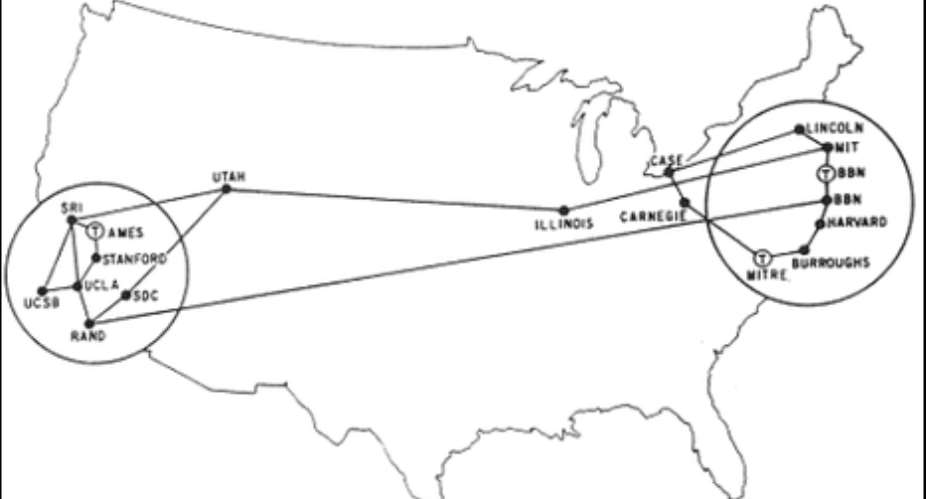
At 2100, on 29 October 1969, engineers 400 miles apart at the University of California in Los Angeles (UCLA) and Stanford Research Institute (SRI) prepared to send data between the first nodes of what was then known as Arpanet.
It got the name because it was commissioned by the US Department of Defense's Advanced Research Projects Agency (Arpa).
The fledgling network was to be tested by Charley Kline attempting to remotely log in to a Scientific Data Systems computer that resided at SRI.
Kline typed an "L" and then asked his colleague Bill Duvall at SRI via a telephone headset if the letter had arrived.
It had.
Kline typed an "O". Duvall said that arrived too.
Kline typed a "G". Duvall could only report that the system had crashed.
They got it working again by 22:30 and everything went fine. After that first misstep, the network almost never put a foot wrong. The rest has made history.
Big changes
Watching remotely in Washington 40 years ago was Dr Larry Roberts, the MIT scientist who worked out the fundamental technical specifications of the Arpanet. The engineers who built the hardware that made Arpanet work, did so to his design.
But, he told BBC News, the initial reaction to setting up Arpanet was anything but positive.
"They thought it was a horrible idea," he said.
Bob Taylor, head of Arpa's Information Processing Techniques Office, wanted Arpanet built to end the crazy situation of every institution he funded demanding ever more computer power and duplicating research on those machines.
"At the time computers were completely incompatible and moving data was a huge chore," he said.
The resistance came about because those institutions wanted to keep control of their computer resources. But, said Dr Roberts, they soon saw that hooking up to Arpanet meant a huge increase in the potential computer power they had at their disposal.
"They quickly learned that there was a tremendous gain for them," said Dr Roberts. It also fulfilled Bob Taylor's goal of cutting spending on computers.
Back in those days, long before the utility of the net was demonstrated, Dr Roberts and his colleagues had an inkling that remarkable things would happen once such a network were built.
"We knew that if we could connect all the data we were collecting that would change the face of research and development and business," he said.
Dividing data
The Arpanet became the internet in the 1970s but the change was largely cosmetic. The fundamental technological idea that made it work, known as packet switching, was demonstrated on that October evening.
The motivation for developing packet switching also had a financial element. Computer networks were in used prior to the creation of Arpanet but not many people used them.
"The cost was enormous because we were doing it so inefficiently," said Dr Roberts. "We knew we needed something to share that rather than have it as a dedicated session."
Analysis by Dr Roberts showed that only one fifteenth of the capacity of a telephone line used to remotely connect to a mainframe was used.
Far better, he reasoned, was to find a way to divide up that capacity among many computers.
Dr Roberts was not alone in building a network using these principles. Packet switching got its name thanks to late British scientist Donald Davies who was creating a network that used this technique at the National Physical Laboratory (NPL).
Not only did it make it easier, and cheaper, to use telephone lines it helped speed up the passing of data.
"If you have packets arriving in little pieces you can very quickly sort them," said Roger Scantlebury, one of Dr Davies' colleagues. "But if you have a huge message you have to wait for that to finish before anything else can happen."
Rather than just theorise, Dr Davies and his colleagues put their work into action.
"When we first started we were just going to build something to show it would work, but fairly quickly Donald realised that in order for it to have any impact it needed to be a proper working system, and we actually built the network which went live at the start of 1970," he said.
He told the BBC News: "When we first put the network together at NPL, we weren't constrained by telephone wires, so we built high capacity links and everyone had 1.5 megabytes, which at the time everyone said was crazy."
From those first two nodes, Arpanet quickly grew and by December of 1969 it had four nodes. By 1972 it had 37 and then started the process of connecting up networks to each other and the internet, a network of networks, came into being.
Dr Roberts has spent his professional life involved in networks and is not done yet. He is currently driving a Darpa research project to get the net ready for the next 40 years.
The work is concentrating on ways to improve security, enshrine fairness so no-one can hog capacity and guarantee quality of connection to support exquisitely time sensitive applications such as remote surgery.
There's no doubt that the net's first step was the start of a giant leap.
Credit: Mark Ward/BBC

 Beijing condemns US move to blacklist Chinese companies
 Trump gets a cold reception at NBA Finals game as Spurs beat Knicks
 One dead, fire officer hospitalised after bee attack at Quarry Site in Sokode Gb...
 Israel and Iran step back from further strikes after renewed clashes
 Patients stranded as doctors, nurses refuse to see new patients over KATH CEO su...
 Avenor Rural Bank CEO’s house destroyed by fire
 Here are areas to be affected by ECG's planned maintenance on Tuesday
 Family of civil engineer killed in alleged military shooting demands justice
 SHS teacher allegedly beats female student over unpaid hostel fees
 Blow to EU defence cooperation as France, Germany abandon joint fighter jet prog...


