




Like many African countries crudely governed by strongmen, Uganda is a country that retains its identity as a nation largely because of British colonial demarcation, not because it has any semblance of political coherence or socio-cultural organicity. And this is painfully attested by the fact that during the more than two decades that Mr. Yoweri Museveni has uneasily held the reins of governance, Uganda has effectively been a nation under siege. And this bleak climate of siege, often verging on an uneasy truce, appears to be showing no signs of abatement. Matters have also not been remarkably helped by the fact that the president who literally shot his way to power via a civil war, and in the process ousting the second Obote administration, has often been commended, largely by the West, for facilitating both a semblance of political stability and the drastic reduction in the high incidence of the Aids epidemic ravaging the country and its citizens. In the 1980s and early 1990s, for example, Uganda was known to contain the highest Aids population ratio on the African continent.
Interestingly, the University of Dar es Salaam-educated Mr. Museveni was widely hailed as a voice of reason amidst chaotic violence about the time that he assumed Kampala's reins of governance, largely facilitated by then-Tanzanian president Julius K. Nyerere. The clinically erratic Gen. Idi Amin had woefully miscalculated the strength of Uganda against that of the more politically and culturally stable and cohesive Tanzania. Mr. Amin, it appears, had childishly confused the personal and physical fragility of Mr. Nyerere with that of the Tanzanian nation itself. The Ugandan strongman was to shortly rue his gross and utter miscalculation, when his hitherto staid and placid southeastern neighbor forced him to take to his heels. Amin, a convenient and belated Muslim convert, having engendered his own acute, albeit well-deserved, humiliation would flee his country of birth and seek asylum in Saudi Arabia, the Islamic holy land, and die a broken man and almost mnemonically obliterated by time. Several times, while in protective exile, Mr. Amin attempted to re-enter Uganda and reoccupy his old presidential palace and thus his old privileged position of president, but each time he was discovered and rebuffed.
The preceding notwithstanding, Mr. Museveni has quite remarkably carved himself the niche of being, perhaps, the most astute and benign of all postcolonial Ugandan dictators; for ever since Mr. Milton Obote shepherded that lush and landlocked country into African self-rule in the early 1960s, Uganda has neither known peace nor comfort. Even the second-coming of Mr. Obote had not proven to be any remarkable improvement on his first-coming, which may partly explain why he was enthusiastically welcomed by the West, when a trim and studious-looking and deliberative sounding Mr. Museveni appeared on Uganda's political landscape.
While I personally expected the man to be far, far better than almost all of his predecessors, particularly coming shortly after the terror-charged stranglehold of the clinically unhinged Gen. Amin, still I had my own reasonable reservations, especially in view of the fact that Mr. Museveni had ascended the Ugandan throne by the force of arms. And true to his mercurial temperament, as the primitive political culture of “strongmanship” rapidly receded into obsolescence and became indefensible, like West Africa's Messrs. Rawlings and Kerekou before him, Uganda's “scholarly strongman” finessed his countrymen and women by staging an electoral charade, in the dubious name of democracy, in which he was the only likely winner. Still, through it all, his fellow countrymen and women, particularly his political opponents, have amply demonstrated that they are too savvy to be taken for a ride.
Under Mr. Amin, there had prevailed a near-absolute culture of silence. With Mr. Museveni, a veritable make-believe culture of a free press has been made to tactically coexist with a vicious state security machinery that operates to ensure that only one party will govern; and that one party, of course, is that which Mr. Museveni smugly operates. And he has successfully done this by roundly and readily incriminating any ideological opponent who appears to be formidable enough to pose a real challenge or even a threat. The last time around, it was to accuse his former personal physician of some sexual misconduct and to have the man promptly incarcerated until any chance of him giving the presidential incumbent a proverbial run for his money had completely fizzled out.
Then about three weeks ago as of this writing (10/3/09), Mr. Museveni issued an edict banning all radio talk-shows in Uganda, on the rather hallucinatory grounds that each and every one of these radio talk-shows has engaged in viciously mendacious anti-government propaganda. “News and information is [sic] good, but when journalists tell lies and cause a crisis, they will be dealt with according to the law. We are not joking anymore. People must respect the rule of law and also be law abiding (See “Uganda: Museveni Orders Closure of Talk Shows” Radio Netherlands Worldwide 9/17/09).
It is not clear whether President Museveni meant to say that either officially allowing the free and salutary marketing of conflicting ideas in Ugandan society is in of itself a joke, or dangerous practice, or that replacing the so-called Bimeeza talk-shows with the Lord's Resistance Army would be a prime recipe for vintage democracy, Ugandan style.
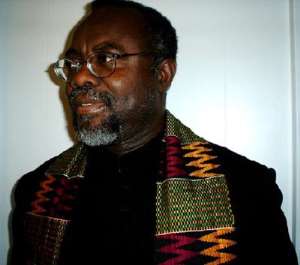
*Kwame Okoampa-Ahoofe, Jr., Ph.D., is Associate Professor of English, Journalism and Creative Writing at Nassau Community College of the State University of New York, Garden City. He is a Governing Board Member of the Accra-based think-tank the Danquah Institute (DI), and the author of 20 books. E-mail: [email protected].
Development / Ghana / Africa/ Modernghana.com

 Belarus manufacturers to storm Ghana next week after President's visit
 Government to offer tax incentives for factories located outside Accra
 White House World Cup chief defends visa ban for Somali referee, Iranians
 Talensi DCE courts investors for revival of Pwalugu Tomato Factory
 Manhyia South MP says free speech under threat, cites 17 arrests in 16 months un...
 KATH doctors suspend strike after Otumfuo’s intervention
 Mahama is losing control of his government — NPP Communicator
 Health Minister’s suspension of KATH CEO technically right — Prof Beyuo
 Korle Bu Teaching Hospital conducts Ebola emergency simulation to strengthen fro...
 Abandoned newborn baby found near gutter at Agona Swedru Woaraba


