




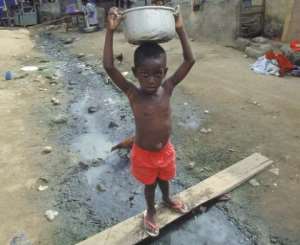
Exam time is tough for children and parents but the results will hold a big surprise from some of the poorest people in the world: children who don't officially exist getting high marks. Their impoverished parents pay for so-called slum schools because they offer better value than free government schools.
"When you compare their examinations marks you will be able to see private school pupil is performing well while that from government is poor," a mother in Nairobi's Kibera told me. In and around this biggest slum in Africa there were 76 low-cost private schools in 2003 (the last proper survey) and the number is constantly rising: they already had 12,000 pupils, compared to around 9,000 in government schools in the area.
Conventional wisdom claims the poor need government education, supported with dollops of international aid. I often visit such government schools in poor countries and find most of the teachers absent. Eager children will be doing nothing, wishing so much to be doing something. As an 11-year-old Kenyan boy told me: "In government schools, there are too many children and too few teachers."
Millenium Development Goals, Commonwealth education ministers and the aid industry all promise free education for all: some countries even pass laws to that effect--with little effect. The poor are moving ahead without them. In Ga in Ghana, only 35.6% of pupils are in government schools, the rest in private, unaided schools.
In poor areas of Nigeria's Lagos State, unaided private schools are even more successful: 42% of pupils are in officially-recognised ones, 33% in unrecognised and only 26% in free government schools.
Most slum-dwellers are not officially recognised as residents so their children often cannot even go to a government school. But that's not the main attraction of slum schools.
"The reason why the private schools are better than the government school is because there is a private owner. If you don't teach as expected, you'll be fired and replaced," a Ghanaian fisherman told me.
His wife, who sells their fish, revealed why parents care so very much about learning: "My father couldn't afford my education, that's why I want Victoria to go to school, so that she won't be disgraced like me.
In the private school, they love and care so much for the kids, and are very serious with the teaching and learning. That's why we decided to put our child there."
In Ghana I was visiting the Atlantic coast, where scores of private schools charge about US$7 per month. In South Africa I have seen them in abandoned office buildings of central Johannesburg. And for the last two years I have been in India, where research reveals at least 300,000 low-cost private schools in the poorest places, charging US$2 to US$5 a month, affordable to rickshaw pullers and daily labourers.
These schools all over Africa, India and China often teach a majority of schoolchildren in urban slums and a significant minority in villages.
If ministers and aid groups acknowledge them at all, they usually allege they are ripping off the poor. But our tests of 24,000 poor children in four countries, including India, found in all cases that low-cost private schools outperformed government schools.
Furthermore, pupils in unregistered private schools, off the government's radar, mean more children are at school than official statistics admit. In Lagos State, for instance, official figures say around 50% of children are out of school. But including children in unregistered schools makes that around 26%--still 26% too many but far less severe.
This market is dynamic and innovative. Less successful schools get taken over. Other entrepreneurs open new schools nearby. Already, embryonic chains are emerging and investors are coming forward, using economies of scale to make improvements that no individual school could afford.
Millions of lives are touched by superior education being offered to the marginalised.
Governments and the aid industry should embrace this movement and accept the limitations of government control. They could make life easier for low-cost private schools by liberalising regulations. Aid donors could help by creating microfinance loans to help the schools improve facilities and by giving vouchers to the poorest of the poor.
Instead, they try to ignore or repress them, keeping pupils out of examinations and closing uncertified schools. But it is too late to stop the poor improving their own lives: officials must join the revolution.
James Tooley is Professor of Education Policy, Newcastle University, England, and author of The Beautiful Tree (Cato, 2009)
 Belarus manufacturers to storm Ghana next week after President's visit
 Government to offer tax incentives for factories located outside Accra
 White House World Cup chief defends visa ban for Somali referee, Iranians
 Talensi DCE courts investors for revival of Pwalugu Tomato Factory
 Manhyia South MP says free speech under threat, cites 17 arrests in 16 months un...
 KATH doctors suspend strike after Otumfuo’s intervention
 Mahama is losing control of his government — NPP Communicator
 Health Minister’s suspension of KATH CEO technically right — Prof Beyuo
 Korle Bu Teaching Hospital conducts Ebola emergency simulation to strengthen fro...
 Abandoned newborn baby found near gutter at Agona Swedru Woaraba


