




The British Labour Party was once counted among the most principled parties in the world. Formed by intellectuals (mainly grouped in the Fabian Society) and trade unionists, it fought for the welfare of the disadvantaged in society.
It helped to build a “welfare state” in which the unemployed were paid a “benefit” so that they wouldn't starve.
The old were given pensions; the sick were looked after in a free “National Health Service”; and houses were built for those who could not pay the high rents charged by house-owners.
Its record in international affairs was also creditable.
Its prominent members included people like Sir Dingle Foot, who defended African nationalist leaders, including Dr Kwame Nkrumah, who fell foul of colonial laws.
Fenner Brockway, a Labour MP, annoyed his fellow Labour Party members in government, by tirelessly questioning their actions in British colonies.
When, in 1956, the then British Prime Minister, Sir Anthony Eden, invaded Egypt in collusion with France and Israel, the Labour Party leader, Hugh Gaitskell, refused to accept that the invasion was “in the national interest of Britain” and denounced the invasion.
He helped to torpedo the secret Anglo-French-Israeli design to permanently occupy the Suez Canal zone and reap huge profits on charges levied through controlling the shipping lanes to and from the Middle East.
A decade later, when the United States, under President Lyndon Jonson, wanted Britain to join the US in its aggression against Vietnam, the British Labour Prime Minister of the time, Harold Wilson refused to do so. Wilson became a cropper by failing to quell the rebellion of Ian Smith and his “cowboy cabinet” in Rhodesia (now Zimbabwe) but his steadfast resistance to the attempt of Lyndon Johnson to co-opt him earned him enormous respect.
But over the years, the Labour Party's original ideals were diluted from within by a succession of leaders who wanted to be second-class Americans.
Jim Callaghan was one of these. But the one who took British subservience to America to another level was Tony Blair.
When Blair got to know that President George W Bush wanted to invade Iraq, Blair immediately constructed a scenario that put Iraq in possession of weapons of mass destruction that could reach Britain “in 45 minutes”.
To prevent Iraq from “firing such weapons at Britain,” Blair joined Bush in raining bombs on Iraq which, according to some estimates, have killed about a million Iraqis — so far.
Blair's lies to Parliament about Iraq's alleged possession of weapons of mass destruction were patently barefaced. Blair's own intelligence chief reported to him, after a visit to Washington, that the Americans were “fixing the intelligence” to suit decisions already made to invade Iraq.
But Members of Parliament elected on the ticket of the great Labour Party closed their eyes to the evidence and their ears to sensible arguments and allowed Blair to have his way, as Prime Minister, and take Britain into a senseless war.
It was evident that the war would stretch Britain's armed forces and deplete its exchequer.
When Afghanistan was added to the list of the Blair enterprise, one had to pinch oneself to believe that one was seeing reality and not experiencing an incredible nightmare.
It was pathetic to observe the inability of the Parliamentary Labour Party to rein in a man who was intent on robbing Britain of its good name and making dangerous enemies for the peaceful people of the country.
One looked for principled people among the Labour MPs.
When Robin Cook, who had been Blair's Foreign Secretary for some time before being made leader of the House of Commons, resigned in March 2003 in protest against the impending Iraq war, one looked in vain for Labour MPs to troop behind him and force Blair's hand to abandon the invasion.
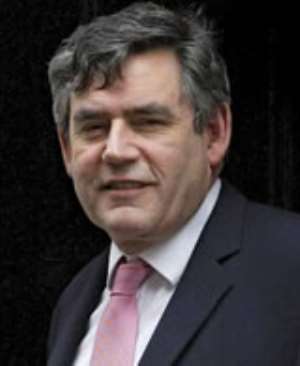
All the while, Gordon Brown sat behind Blair, plotting how to get rid of Blair but not because he wanted to give expression to the country's hatred of the war, but to satisfy his own personal fierce ambition to be Prime Minister. On June 27, 2007, Blair resigned and Brown took over.
But those who had hoped that Brown would read the signs and abandon Blair's hopeless war adventures in Iraq and Afghanistan, were to be disappointed.
Brown continued as Blair had done, and except for the fact that he cut a less charismatic figure than Blair, it appeared as if nothing had changed.
In the latter half of 2008, Brown showed his true colours for all to see. By a series of greed-induced gambles, some of the most respected banks in Britain suddenly found themselves floundering.
They had taken on their books, huge amounts of “sub-prime mortgages” and other debts that they could not finance out of their own resources.
Afraid that if they lent money to each other, they would never see the money gain, the banks caused inter-bank lending to freeze. In the USA, Bear Stearns Bank, Lehman Brothers and other big financial institutions were allowed to fold up. AIG, however, was deemed too big to fail and rescued.
In Britain, Brown used taxpayers' money to bail out almost every bank that was in trouble or to arrange for their fairly painless takeover.
Even when the rescued banks outraged the citizenry by paying huge bonuses and pensions to some of the executives who had led them into near-liquidation, Brown showed little concern.
Meanwhile, thousands of ordinary citizens who were in danger of losing their homes because they had been misled into borrowing more than they could repay, were largely left to their own resources.
Some assistance was offered them, but they paled into insignificance compared to the billions the banks had swallowed.
Wasn't the Labour Party supposed to be the common man's friend, which would tax the rich in order to help the poor? Under Brown, the exact opposite happened — billions for the rogue banks and very little for the common man.
And then, a scandal broke out which showed that the rich-friendly policies being followed by the Labour Party under Brown, did not come out of thin air.
The MPs who were supposed to go to Parliament to safeguard the welfare of the people, were carrying out all sorts of skullduggery.
Some MPs were claiming refunds for mortgage interest on two homes instead of the single homes to which they were entitled; others were buying all sorts of things and charging them as necessities for their homes.
One MP even charged the state for employing people to clean the moat outside his castle! The scandal of the MPs' fiddled expenses has been enjoying prominence in the media for about four weeks now.
Unfortunately for Brown, the scandal broke out just before council elections and elections to the European Parliament were held.
And the electorate used these elections to make Brown aware that they held him responsible, as Prime Minister, for the rot that set in at Westminster.
Some ministers and MPs are now deserting Brown because they have seen how weak he has become.
But there doesn't appear to be anyone who can lead the Labour Party and help it to rediscover the principles that once made Labour so strong, and convince the electorate that Labour has reformed itself and is still worthy of trust.
Yet if it is Brown who leads the Party into the next election — which is due in a year's time — it appears likely, from this week's electoral results, that Labour will be lucky if it is not wiped off the face of British politics for some time.
Ghanaian politicians who didn't learn their lesson from the 2008 elections, had better study the Labour Party's debacle closely. Yes, it is true that you cannot deceive the public for ever.
Credit: Cameron Duodu (The Ghanaian Times)

 One dead, fire officer hospitalised after bee attack at Quarry Site in Sokode Gb...
 Israel and Iran step back from further strikes after renewed clashes
 Patients stranded as doctors, nurses refuse to see new patients over KATH CEO su...
 Avenor Rural Bank CEO’s house destroyed by fire
 Three arrested in Winneba for illegal mining near GWL water lines
 Two pupils of Alice Elite Academy laid to rest after fatal school bus crash
 Here are areas to be affected by ECG's planned maintenance on Tuesday
 Family of civil engineer killed in alleged military shooting demands justice
 SHS teacher allegedly beats female student over unpaid hostel fees
 Blow to EU defence cooperation as France, Germany abandon joint fighter jet prog...


