




"The Americans have not been shy in establishing a clear economic link alongside their military cooperation. Ghana is one of the few African nations, mainly those with oil, selected for the State Partnership Program to promote greater economic ties with U.S. institutions, including the National Guard. Expanding this to deepen our cooperation with the Drugs Enforcement Agency is one other area that President Mills should focus attention on.
"A good deal depends on both an understanding of the cards in your hands and your opponent's, and the skilful and strategic play of these cards. The first of these cards that the Ghanaian government must not fail to appreciate is the fact that Superpower America now sees West Africa as a zone of strategic importance – it's no longer a question of just us needing them, but they now also need us.
"Our trump card is of course oil. But if we are to prevent ourselves being played by the U.S., we must deploy this to maximum benefit: ultimately it is up to Africans to selfishly see our oil as means to provide energy security to others in exchange for support for more rapid African economic development."
As the visit of US President Barak Obama approaches, the pro-AFRICOM lobby in Ghana are strident in their claims of the economic benefits of the US military bases to the local economy. It looks as though, they want to tell us that in addition to the revenue to be accrued from the oil industry, we are also to benefit from the installation of US military bases. I wish to God that this article could help put to rest such type of nonsense as we clear our heads to deal with real and present dangers. So far as I am concerned, this national call for discussions over the economic benefits of a foreign military occupation is no different from a discussion about the economic benefits of slavery to the slave. Yet this is exactly what the US military industrial complex and their local agents are obliging us to engage in, without any shame.
There is no doubt in my mind that this whole vague idea that somehow the establishment of military base would have any economic benefits must really be based simply on the silly suspicions of a few ill-informed individuals. In the first place, the deployment of US forces across the globe is not done in a homogeneous manner. So it does not even make any sense to talk about the economic benefits when you do not know what type of base it is going to be. There are remarkable differences and practices of the US military around the world. It has been noted for example that marine bases are relatively less likely to create more criminal behaviour than Air Force bases, whilst naval bases are notorious for the regular visitations by rude, arrogant, and sexually aroused young men and women often in their thousands, looking for sex and alcohol. With this business profile the only sections of the economy that stands to benefit from this would be the drinking bars and the prostitution and beer industries.
Before we get carried away, it is important to know what we are talking about. Watching the behaviour of Mr. George Bush after the eleventh September, one gets the impression of observing a dog eager to run just at the moment the master's goat gives that pretext by breaking loose! I would not go as far as to speculate whether or not it was staged to justify a certain course of action, but I can go as far as to say that the weapons of mass destruction charges against Saddam Husein were fabricated to justify an unjustifiable invasion. All these are a part of a pattern of increasing militarisation of international diplomacy made worse by the right to preemptive war, all in a grand design of obvious global domination. The real question ought to be "What are the benefits of imperialist global domination to your local economy?"
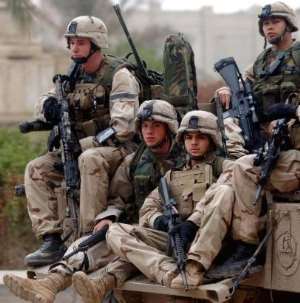
Military bases are “installations routinely used by military forces.” If they are soldiers from one's own country, the chances are that in a democracy the citizens can control their excesses through their governments. However, the confluence of labor (soldiers, paramilitary workers, and civilians), land, and capital in the form of static facilities, supplies, and equipment belonging to a foreign army is a different matter. "Bases are just the most visible part of the larger picture of U.S. military presence overseas. This picture of military access includes U.S. military training of foreign forces, often in conjunction with the provision of U.S. weaponry, joint exercises meant to enhance U.S. soldiers' exposure to a variety of operating environments from jungle to desert to urban terrain and interoperability across national militaries, and legal arrangements made to gain overflight rights and other forms of ad hoc use of others' territory as well as to preposition military equipment there."
Our best place in this scenario is that of glorified pawns, or a story of a rich and powerful people who accepted a Greek gift and became slaves in their onw very rich country. No transportation needed, no need to feed them, and all the other inconveniences of the trans-Atlantic slave trade.
The reason why I decided to answer this question is to put this question to sleep so that we can find the space to raise the debate to where it belongs: an act of a greedy invader through lies and deceit, and a call to apprehend and deal with the local collaborators, President J. A. Kufour, Lt. Gen. J. B. Danquah, and Dr. Addo Kufour and other leading members of the NPP who were privy to the conspiracy to sell us to the Americans through the secret preparations for the establishment of foreign military bases within the territories of the Republic of Ghana without informing anyone!
Before we come to that, here are a few interesting cases that show the impact of the US bases on the local populations:
Case Number One: the removal of the U.S. Navy from Vieques, Puerto Rico in 2003
Since these troubling events, the number of countries into which the U.S. slowly but surely seeking to establish bases in are expanding rapidly. We see them particularly in Africa, Central Asia, and Latin America. In spite of the overwhelming sympathy that greeted the US after the attacks of the 9/11,sustained campaigns of direct action and political lobbying resulted in the removal of the U.S. Navy from Vieques, Puerto Rico in 2003. "The success of this anti-base campaign, where others had failed, was due in part to the use of arguments about the deleterious environmental and health effects of military activities on the island. This argument also remains the centerpiece of resistance to military activities on and around domestic U.S. bases." (Catherine Lutz, Bases, Empire, and Global Response. www.forusa.org)
Case Number Two: Voices from Chamoru
In the summer of 2007, Two Chamoru representatives from Guam visited Australia for a month-long international awareness campaign and accused the United States of glaring human rights violations of the indigenous Chamoru people. It is an interesting case because if there are any economic impact to be expected per ratio of local population, in Guam the ratio was one is to one. The island's entire indigenous Chomoru population stands at 55,000. The Americans are seeking to base 55.000 troops there. The military build-up now underway in Guam, which will include an influx of a military personnel population comparable in size to the entire indigenous population (55,000), is being done entirely without the input or consultation of the local people. Asking the people of Guam the benefits of a military base is like asking a rape victim the benefits of being raped!
'“The new wave of U.S. militarization of Guam means to be decisive,” said Chamoru writer Julian Aguon in Sydney today. “It is not simply more of the same. Part of the U.S. military realignment in the Asia-Pacific region includes the controversial relocation of 8,000 U.S. Marines from Okinawa, Japan to Guam. The move will have devastating consequences for the indigenous Chamoru people, who have been struggling for decolonization of their island home.
“The situation of Guam serves as one of the greatest indictments of U.S. democratic legitimacy, as Guam remains one of only 16 non-self-governing territories in the modern world. The military build-up now underway in Guam, which will include an influx of a military personnel population comparable in size to the entire indigenous population (55,000), is being done entirely without the input or consultation of the indigenous people and over their deepening dissent.”
Dr. Lisa Natividad, a professor at the University of Guam, stated that the new wave of military buildup will only worsen the well being of the Chamoru people, who already suffer from the classic symptoms of a colonial condition such as dramatic health disparities. “For example, rates of nasopharyngeal cancer among my people are 2,000% higher than in the United States, and the rate of diabetes is five times the national U.S. average,” Dr Natividad said.
“Although Guam is only 30 miles long, it contains 19 sites designated by the US Environmental Protection Agency as the most highly contaminated and toxic sites in the entire United States.” Dr. Natividad said. These toxins include radioactive and carcinogenic materials, dioxins, etc.
“We come to Australia in the hope of raising awareness about the human rights deprivations of the Chamoru people by the U.S, to build solidarity among the peace and justice groups here and throughout the Asia-Pacific region, who are all endangered by current U.S. militarization of the region,” she said.' (Source: US ACCUSED OF HUMAN RIGHTS VIOLATIONS, http://www.anti-bases.org/)
Case Number Three: The Italians have had enough
In methods of social research, I don't know what to make of it, but if I see tens of thousands of people marching as they did in the north-eastern Italian city of Vicenza against a planned extension of the US army base there, I know from this that the much vaunted economic impact has not tipped the scale. This demonstration was organised because the majority of local people are opposed to US plans for expansion. They said Prime Minister Romano Prodi had ignored strong local objections. Mr Prodi was going ahead with a plan agreed by his pro-US predecessor, Silvio Berlusconi.
Case Number Four: The Okinawans flex their muscle and win
The United States was forced to back down over its plan to build a large offshore military base on the southern Japanese island of Okinawa after local protests stalled construction. Reports said "Washington and Tokyo had wanted to build a heliport and 1.5-mile runway over pristine coral reef more than a mile offshore, near Heneko village. But the plan enraged many locals on the small island, which already hosts around half of the 37,000 American troops stationed in Japan."
Environmentalists joined the opposition to the planned base, saying it would destroy the reef, which is home to the dugong, an endangered species of sea mammal. (Source: http://www.independent.co.uk/news, US military retreats over Japanese base after protests by islanders, by David McNeill in Tokyo, Thursday, 27 October 2005)
It is clear in all these cases that the local people are not happy with the establishment of bases in their territories. You can say the same of South Korea to Saudi Arabia, in Germany and and even within the US there are local communities complaining about the installation of US military bases with a long list of grievances. Prominent among them are the environmental impacts which include "effects on air quality, fire potential, noise pollution, waste disposal and spills and erosion from amphibian craft landings and weapon target zones, collisions with marine mammals, and contamination from toxic chemicals including red and white phosphorus and perchlorate."
Catherine Lutz continues:
"For years, then, the movements have logged and described past and current confiscation of land; the health effects from military jet noise and air and water pollution; soldiers' crimes, especially rapes, other assaults, murders, and car crashes, and the impunity perpetrators have usually enjoyed; the inequality of the nation-to-nation relationship often undergirded by racism and other forms of disrespect; the culture of militarism that infiltrates local societies and its sequel in higher rates of enlistment, death, and injury to local youth; the cost to local treasuries in payments to the U.S. for support of the bases; and the use of the bases for prisoner extradition and torture."
The returns on such a massive investment to the local economy may include high sales for condoms and alcohol, anything beyond that is trouble! Catherine Lutz points out:
"The U.S. military owns (or rents) over 28 million acres of land and $600 billion dollars worth of real estate, and these bases bristle with an inventory of weapons whose worth is measured in the trillions and whose killing power could wipe out all life on earth several times over. Deployed from battle zones in Afghanistan and Iraq to the quiet corners of Curacao, Korea, and England, its domain consists of sprawling Army bases, small listening posts, missile and artillery testing ranges, and berthed aircraft carriers. While the bases are literally weapons depots and staging areas for warmaking and ship repair facilities and golf courses and basketball courts, they are also political claims, spoils of war, arms sales showrooms, toxic industrial sites, laboratories for cultural (mis)communication, and collections of customers for local bars, shops, and prostitution." (Bases, Empire, and Global Response, by Catherine Lutz.)
"Some communities pay the highest price: their farm land taken for bases, their children neurologically damaged by military jet fuel in their water supply, their neighbors imprisoned, tortured, and disappeared by the autocratic regimes that survive on U.S. military and political support given as a form of tacit rent for the bases. Global opposition to U.S. basing has been widespread and growing rapidly, however, in vigorous campaigns to hold the U.S. accountable for that damage and to reorient their countries' security policies in other, more humane, and truly secure directions." (Bases, Empire, and Global Response, by Catherine Lutz.)
It is clear that if you are not a commander of the US Army, you better not stand in their way, once they install themselves and settle down. That is why I find this question Ochere-Darko has raised the most tedious and offensive question I have come across ever since I was born as a free citizen over half a century ago! If you want to have an idea of military treatment even after a friendly invitation read the diaries of Sergent.. and how he treated the King of Manpong. This is a subject that gives you all your rights before the negotiation and takes them away once you enter into an agreement because after that, you are nothing, and your opinions do not matter. After all, how many of us are military commanders of the US Army? And what exactly are they asking from us? Why so many lies?
We have two adults who should know better, Bush and Kufour lying to Ghanaians and the world that it was not true the US was even preparing to install a military base in Ghana. Ye they meet and secretly plot exactly that! "The purpose of this is not to add military bases," Bush said. "I know there's rumors in Ghana -- 'all Bush is coming to do is try to convince you to put a big military base here.' That's baloney. Or as we say in Texas, that's bull." - Mr. George W. Bush, (President of United States of America in Accra, Ghana. February 20, 2008.)
So why is Mary Carlin Yates, AFRICOM's top civilian employee, saying that they are coming in with five battalions by 2010? “When I was U.S. Ambassador in Ghana, we had a robust military-to-military program. We started the State Partnership Program. What we want to do is to find the African partners who are looking to build peace and stability in their nations and in their regions – partnering with those African standby forces as they build their goal is to come online with battalions for each of the five geographic areas by 2010”. (Source: Ghanaians Discuss AFRICOM & Obama's Visit Posted by xcroc )
As they work around the clock to establish their bases, obviously ignoring whatever our sentiments might be on the matter, they would still find some appropriate words to explain why those of us complaining against this mind-boggling swindling of a whole country, the bad guys. Those who are looking for local impact must find out from the Okinawans, they must know after all these decades, yet even there we see that most polls show 70 to 80% of the island's people want the bases to removed. Most of them value the economic benefits of the land on which the bases are based than the bases themselves.
Another complain that they find unbearable is the constant risk of aviation crashes as well as higher rates of prostitution, drug trafficking, and sexual assault and other crimes by U.S. soldiers. "For years," writes Catherine Lutz, "Okinawans have staged large protests, linking hands and encircling large bases in their entirety, and sitting-in for months at the site of proposed new military construction. One family built a large peace museum right up against the edge of the fence to Futenma Air Base there, with a stairway to the roof which allows busloads of schoolchildren and other visitors to view the sprawling base after looking at art depicting the horrors of war."
In his article, Ochere-Darko cites a statement attributed to Mr. Ken Ofori-Atta of Databank at Chatham House recently, "So whatever is on offer to countries like Ghana by the IMF and World Bank only follows the old pattern of development assistance never matching what is taken out from Africa." I wonder why no one has done the simple arithmetic as to who is going to pay for the bases. Is there any good reason why it will not the "old pattern"?
"Much of the U.S.'s unparalleled weaponry, nuclear and otherwise, is stored at places like Camp Darby in Italy, Kadena Air Force Base in Okinawa, and the Naval Magazine on Guam, as well as in nuclear submarines and on the Navy's other floating bases. The deadliness of its armaments – nuclear, chemical, biological, and “conventional” – matches that of every other empire and every other contemporary military combined. The weapons, personnel, and fossil fuels involved in this U.S. military presence cost billions of dollars, mostly paid by U.S. taxpayers, but an increasing number of billions come from the citizens of the countries involved. Elaborate bilateral negotiations exchange weapons, cash, and trade privileges for overflight and land use rights. Less explicitly, but no less importantly, rice import levels or immigration rights to the U.S. or overlooking human rights abuses have been currencies of exchange."
So much for the local economy!
And this must be instructive to note the destructive extent of these bases on the lives of the local people: the original inhabitants of Diego Garcia, evicted from their homes between 1967-1973 by the British on behalf of the U.S., have organized a concerted campaign for the right to return, bringing legal suit against the British government.
--
Nana Akyea Mensah
http://nanaakyeamensah.blogspot.com/
PS
Whenever the Danquah Institute Mimics Kwame Nkrumah, It Stinks!
Obama's chief policy adviser assured Africans two months before the 2008 presidential race, “Barack Obama understands Africa, and understands its importance to the United States. Today, in this new century, he understands that to strengthen our common security, we must invest in our common humanity and, in this way, restore American leadership in the world.” Now is the chance for him to seek and effect the real change that will finally show the world that Africans are capable of more than managing their own affairs – but, crucially, Ghana must take up the opportunity provided by the state visit and the U.S.'s burgeoning strategic interest in us, to be the nation that demonstrates this.
What I want Asare Ochere-Darko to explain to me is just how we are going to manage our own affairs with guns pointed on our heads? Telephone conversations constantly monitored, and all suspects are stripped of their human rights? I am not surprised you did not get it right, If you had gotten this right, what could have explained his presence in the Busia Danquah Institue?

 Former MASLOC CEO Sedina Tamakloe returns to Ghana after extradition to serve 10...
 Tension in Birim North as angry NDC youth attempt to disrupt cooperative mining ...
 One dead, several injured in tipper truck and fuel tanker crash on Accra–Tema Mo...
 How 70-year-old building was finally demolished over fear of collapse in Osu
 Minority MPs thank Afenyo-Markin for capacity-building programme in Canada
 Ghana has everything needed to prosper yet graduates remain unemployed — Dr Step...
 June 9: Cedi sells at GHS12.50 on forex market, GHS11.85 on BoG interbank
 Stephen Amoah advocates mixed market economy to tackle rising cost of living in ...
 KMA to reintroduce enhanced ‘Samansaman’ sanitation enforcement system from July...
 Nyinahin Catholic SHS teacher seen fighting female student in viral video arrest...




Comments
I am happy there are still people who talk sense and know that america and her allies are threats to Africa.