




A lifetime of selfless devotion to education
The Persistence of Paradox: Memoirs of F.L. Bartels set a national milestone. It was first published by Ghana Universities Press, Accra; and a fresh edition is available through www.lulu.com.
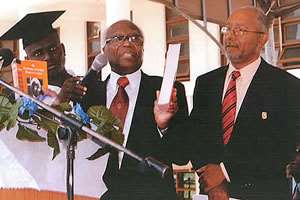
The energies from Mr Bartels's trials and successes in education in Ghana throbbed from the colonial times of Governor Gordon Guggisberg through Dr Kwame Nkrumah to the present. The launch of his book at the Teacher's Hall, Accra (September 24, 2003) confirmed the headmaster's resolve not to rest from labour. His ambition was matched by his drive, and served by an eager ego.
It was awesome witnessing the proud readiness of the grand old man lead the gathering of admirers to a bone-chilling rendition of the Mfantsipim hymn “For all the saints who from their labours rest”. Many had missed our dear song for decades and now sang it with proud passion. With the sonorous tone of (the late) Methodist Rev Prof Kwesi Dickson and Dr J.A. Addison adding grace from the dais, the evening was unforgettable.
Though 93 years old at that launch, Mr Bartels continued to stand nimbly, unwavering in his gait, reverend in his modesty, and sharp in his mind. His vigour – in fresh bouquets of gaiety and purpose - coaxed the younger men under 90 years to avoid the mid-day naps. The commitment inspired a surge and a clarion call to measure to the top, and peruse the twin-tower of perseverance and leadership. Ghana was the richest, having claimed landmarks through him.
Back in 1949, pondering his first speech day, the new African headmaster recalled: “The window on my right looked out to a new vastness of the Gulf of Guinea and a new majesty of the Atlantic Ocean beyond … My horizon was widening.” This moment was but the early spring of his long stewardship. Following the heels of his trials and triumphs was the advice of Rev R.A. Lockhart (headmaster 1925 – 1936): “keep discipline. Without it all is lost. I had learnt the lesson in the First World War, and I applied it at Mfantsipim.”
In his day, headmaster Bartels was a legend for integrity and quality education in Ghana. And Mfantsipim responded in kind with panache and aplomb in sync with Bartels's own standing. Like the Reverends W.T. Balmer and Lockhart, few were better placed as guides to education in the Gold Coast, and Mfantsipim in particular.
The Persistence of Paradox is a superb 377-page work of riveting insights and humour. The narrative gifts of Mr Bartels lifted the reader breezily through the author's growth at Mfantsipim, years at Unesco and, finally as Ghana's ambassador to Bonn, Germany.
A visionary eye cast to unfold backwards is always a treat. It blows the lid right off an impending future, and reveals the trump cards to posterity. Rather than the clamps from nostalgia that crippled many lives, what a reward for a first class educator to share his impressions! When the history of education in Ghana is settled, one of the greater influences will surely be Mr Bartels: Like the seers Mensah Sarbah, Kwegyir Aggrey, Ephraim Amu, R.P. Baffour and others, the list of his heirs is endless.
In a foreword to the book, Mr Kofi Annan, the former U.N. secretary general recalled, “I was one of a group of boys who sat on the floor of his office for our weekly lesson in 'Spoken English' … Each day takes me a little further on the road Headmaster Bartels helped to pave.”
It's instructive how instinct draws visionaries to pay homage to others. Mr Bartels was clearly impressed by the nation's founder. With Nkrumah, he wrote, many felt “we could not continue to be treated like children by the British”. He discerned Nkrumah's greatness in two areas including a national consciousness (which evolved into the famous code of the African personality): “First, [Nkrumah] managed to rise impressively above tribalism. … Secondly, he had a deep concern regarding purposeful higher education… he began developing his idea of a university for the preparation of educators. 'Me university no o!' (Please, give maximum thought to my [Cape Coast] university!)' he said, passionately”. The Kumasi one, the Kwame Nkrumah University of Science and Technology (KNUST), was already on course.
Alongside this thread of Nkrumah's foresight ran another thread as dark as the other was bright. Mr Bartels's discontents with the Osagyefo included the Prevention Detention Act, and the “bid to build our future on the sands of loyalty to himself”. He bemoaned the national sorrow caused by this fatal flaw.
Mr Bartels's genius (to my mind) was profound in his vision for the University College of Cape Coast to which he was being considered “Principal-designate”. His successes at Mfantsipim were fait accompli; they kept safe distances from sympathy. But that which ought to have been but wasn't to be: that was the pity. I mean the fusion of Nkrumah's vision with Mr Bartels's to build a great society in Cape Coast. Mr Bartels's emotions were cast gloomily on this matter: “I frequently looked back at our national education from the University of Cape Coast, which I might have headed… More often than not was depressed by the sombre fate”.
There's a sorrowful satisfaction in knowing that one is not alone in these thoughts. With a maverick lending his credence, posterity might develop a thick skin to avoid a future mishap. Let's follow Mr Bartels's strategic sense (as a member of an initial committee of four charged to shape the new university):
“I did my best to persuade [Commissioner Hagan] to consider building the new university on, and among, the hills of Cape Coast [to] function as an enabling institution [to] give as well as take, grow and become a part of the town and learn to assist it in solving its problems. The project's possibilities were vast. Mount Hope could be a strategic point [to] begin and mesh with the slum clearance envisaged for the town… making it imperative for university personnel [to use] local amenities [and] in their own interest demand efficient management.
“The Cape Coast Castle could be converted into a research library and flats to promote academic tourism and a university extramural programme, [to] ultimately extend to the other castles and forts along the coast. The Cape Coast churches could be university chapels. Lastly, the Victoria Park …might be turned into an open-air theatre to promote drama and other cultural activities for town and gown”.
The Plan
The plan implied a re-invention of higher education for “hands-on” social and economic good. It was a masterpiece, and was sold in a way in which it had to be bought. But, the Commissioner was not moved; he craved “another Legon…a self-contained showpiece [with] a separate existence”.
To Mr Bartels, “Another Legon, Accra, was the last thing Nkrumah fancied. But he got it.” The Commissioner's thinking was like that of David Balme, a classics scholar of repute, the founding principal of Legon, who admitted: “You've asked me to establish a university. The university I know is Cambridge.”
Mr Bartels envisaged the thrust of the sciences “to direct the thinking of students to education for work, using the environmental resources of the area, [for example] the fishery industry that was being developed at Elmina [and] the support it would require from the interdisciplinary research in Geography, Meteorology and Refrigeration Engineering”.
The plan was ignored. A later report from an “International Commission [with] Geoffrey Bing” came out, placing reliance on prospects “no different basically from Legon”.
In seeking a new deal for education in Cape Coast, Mr Bartels's ideas, perhaps, created a discomfort, or worse, fear. The colonial mindset was shaken. The new thinking implied a shift from the obsolete lecturing-and-copying format, to a preference for a purposeful re-design of teaching and learning in the wider context of a hands-on urban renewal. Without an assertive, practical access to freedom of judgement and imagination, education itself is stale.
Cape Coast, as an education capital, stood to generate a livelier, intellectual, research, and superior tourist industry, with leverage for clusters of jobs. The intellectual, the economic and the social go together. With a better quality of life, professional people who deliver important services would stay. An urban renaissance created a dynamic and capacity strengthening a wider area.
A vision-gap is a costly thing. Many university towns have blazed that trail and flourished in the midst (not on the periphery) of urban renewals; for example, the connection between the University of California, Los Angeles and the city of Westwood (in the U.S.), and the penchant of that union for creating employment, and student jobs.
Mr Bartels's vision, alas, shunned the habit of skimping on the maintenance of existing national assets, pouring good money into newish things, and setting in train a cycle of neglect. Possibly, the disregard for the plan mirrored two puzzles: one, the naïve assumption that, somehow, distribution of benefits is a zero-sum game; and two, the elitists' phobia for the teeming masses, and preference for the suburban nest and rest.
For a new, independent nation, the opportunity loss was worse than a study of reflexes in the aristocratic psyche. It was hard to escape the suspicion that what was bliss for Cambridge turned out to be bale to Cape Coast. As between liberation and servitude, Mr Bartels drew the line between visions of national self-assertion and timid copies of the archaic.
The past is all very well. But why misjudge the echoes of the times? The outdated wisdom that tertiary education has to be packaged, somehow, within enclosed quarters has become as insidious as the insistence that every phone has to have wires attached. Now the times give the proof that functional illiteracy is the virus to dismantle, and purge.
The Persistence of Paradox is a must read. As a biography, the canvas is full with the texture and colour of a life spanning almost a century. It draws seamlessly on a vast repertoire with anecdotes, some highlighted with fun (and slaps) in Akan (Fanti): (Nkye mobobo n'asowa mu ma w'atse). Mr Bartels's other books include, the 2007 latest, “Journey out of the African Maze: Indigenous and Higher Education in Tandem” (www.lulu.com); and “Roots of Ghana Methodism” (Cambridge University Press, 1965).
In talking with Mr Bartels, his personal takes on key historic events and people, and the details in the making of those experiences, held one glued like a bond. More grease to his years. Mfantsipimfo, the Methodist Church, and the nation at large should be geared, properly, for Mr Bartels's 100 years anniversary, 13th March 2010. He gave so much to broaden and elevate the nation's collective thought. [This piece, published in a different form in 2004, is revisited for the anniversary].
[Anis Haffar, the author, is the founder of Gate Institute, a consulting service for continuous teacher education in English Language skills, and Methodologies for Leadership-centred teaching for primary, secondary, and tertiary levels. Email: [email protected]. Website: www.gate.ghanaschoolsonline.com]
 One dead, fire officer hospitalised after bee attack at Quarry Site in Sokode Gb...
 Israel and Iran step back from further strikes after renewed clashes
 Patients stranded as doctors, nurses refuse to see new patients over KATH CEO su...
 Avenor Rural Bank CEO’s house destroyed by fire
 Three arrested in Winneba for illegal mining near GWL water lines
 Two pupils of Alice Elite Academy laid to rest after fatal school bus crash
 Here are areas to be affected by ECG's planned maintenance on Tuesday
 Family of civil engineer killed in alleged military shooting demands justice
 SHS teacher allegedly beats female student over unpaid hostel fees
 Blow to EU defence cooperation as France, Germany abandon joint fighter jet prog...


