




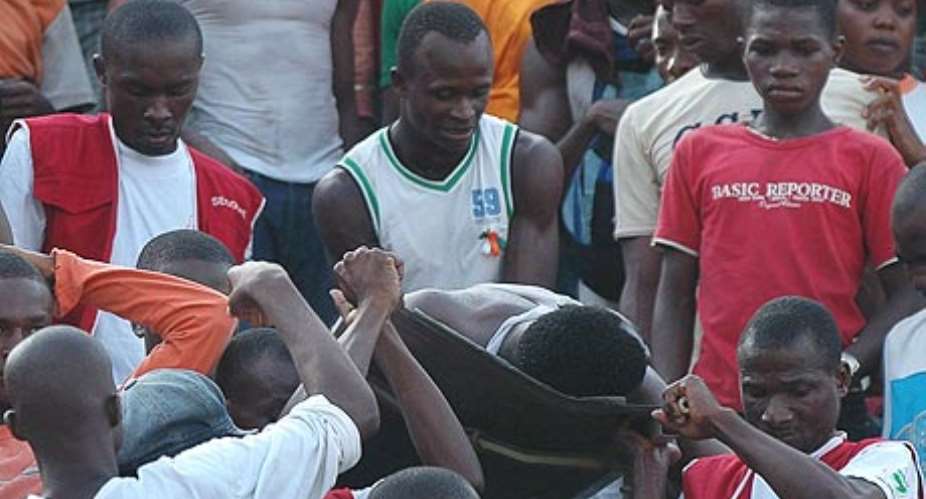
After 19 deaths in yet another stampede, it's time to ensure African stadiums are built to the same standards as elsewhere
The people of Africa have been killed in football stadium disasters year after year. The worst occurred in Ghana on 9 May 2001 when 123 people were killed after the police fired teargas into crowded stands and a stampede for the gates ensued. Just a month earlier, 43 people had been killed in Johannesburg, South Africa, after spectators had stampeded there too, during a match. At least 10 similar incidents cost scores of lives all over Africa between 1996 and 2009. Yet on 29 March 2009, another disaster was allowed to occur in Ivory Coast, killing 19 people.
The controlling body of world football, Fifa, has sent its condolences to the Ivorian Football Association, and has demanded an inquiry into the disaster. Ivorian prime minister Guillaume Soro and his cabinet are also seeking ways of preventing future soccer disasters. Meanwhile, President Laurent Gbagbo has ordered three days of national mourning, and has asked prosecutors to find out whether anyone is culpable for the tragedy.
But exactly this sort of inquiry is instituted each time such a disaster occurs. What happens to their findings? Does Fifa distribute them to all its members, with a demand that they draw lessons from what happened?
The frequency and similarity of the disasters suggest that Fifa may not have done everything in its power to ensure the safety of African football fans. Football constitutes the single most important – if not the only – entertainment provided on a large scale for the populace of many African countries. International matches, in particular, are not only well patronised but produce such a fervour in the stands it is sometimes frightening to visiting teams.
Everyone knows this, and there is also enough money in the game for Fifa to help the Confederation of African Football finance a rebuilding of the outmoded stadiums where these disasters occur. But the two bodies are very friendly towards each other, and this makes it difficult for Fifa – whose top officials are periodically elected by the local associations – to read the riot act to the African associations and concentrate their minds on anticipating and preventing accidents.
The question of tough measures aside, it is a fact that many of the current African stadiums were built by governments, and the more indigent of them were unable to employ the best architects available to design and construct stadiums with a failsafe capability.
Certainly, the situation has reached crisis proportions, and Fifa must lay down strict rules for constructing stadiums in Africa. When similarly dangerous situations used to occur in Latin America, Fifa ordered the institution of drastic measures there, including the construction of moats round playing fields. Africa needs similar action. If the governments plead that they cannot afford to construct stadiums that meet Fifa's rigorous standards, Fifa must lend them the money and recoup it from future gate receipts. Currently, the African continent is nurturing some of the greatest entertainers in the game and in return, Fifa should help to make watching football in Africa as safe and comfortable as it is elsewhere.

 One dead, fire officer hospitalised after bee attack at Quarry Site in Sokode Gb...
 Israel and Iran step back from further strikes after renewed clashes
 Patients stranded as doctors, nurses refuse to see new patients over KATH CEO su...
 Avenor Rural Bank CEO’s house destroyed by fire
 Three arrested in Winneba for illegal mining near GWL water lines
 Two pupils of Alice Elite Academy laid to rest after fatal school bus crash
 Here are areas to be affected by ECG's planned maintenance on Tuesday
 Family of civil engineer killed in alleged military shooting demands justice
 SHS teacher allegedly beats female student over unpaid hostel fees
 Blow to EU defence cooperation as France, Germany abandon joint fighter jet prog...


