




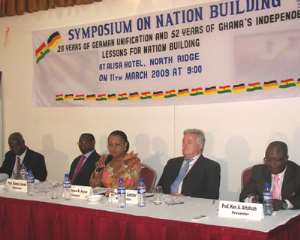
PAPER PRESENTED by Dr. Sebastian K. Bemile AT THE SYMPOSIUM ON NATION-BUILDING
ORGANISED BY THE KONRAD-ADENAUER-STIFTUNG ACCRA, 11TH MARCH, 2009, 9HRS, ALISA HOTEL, NORTH RIDGE-ACCRA
THEME: “52 YEARS OF GHANA'S INDEPENDENCE AND 20 YEARS OF GERMAN UNIFICATION”
TOPIC: “NATION-BUILDING IN GERMANY AND GHANA: LESSONS FROM HISTORICAL EXPERIENCES”
Dr. Sebastian K. Bemile
NATION-BUILDING IN GERMANY AND GHANA: LESSONS FROM HISTORICAL EXPERIENCES”
1. Definition Of Nation-Building
In simple terms, nation-building is defined here as a process of socio-political development. This process of development may result in a common social order or body politic with its own system of state stemming from lose or conflicting communities. The process necessarily lead to the establishment of common cultural standards, such as a common language and the integration of future parts of the population into socio-cultural and political entities like a legal system, educational system or electoral system. In nation-building the powers that have been achieved are legitimised through militarily, administratively or economically dominant control mechanisms.
“Nation-building entails creating, [for instance,] national symbols like flags, national anthems, national statutory holidays, national stadia, national airlines, national languages and national myths”. (Anderson, In: Wikipedia Encyclopaedia, 2005).
It is also imperative to create a national identity.
2. Historical Analysis of Nation-Building
In order to be able to understand the present conditions and status of Nation-Building in Germany and Ghana it is relevant to take at least a cursory look at the historical development of Nation-building in the two countries, especially with regard to the experiences which characterise the said development.
3 .1Germany
The present German nation dates back to the era of the Germanic tribes, such as the Alamanni, Franks, Chatti, Saxons, Sicambri and Thuringii, whose ethnogenesis occurred during the Nordic Bronze Age or during the Pre-Roman Iron Age were quite vibrant between 100 BC and 300 AD. For the purposes of our discussion here we can only cast a cursory glance at certain historical highlights that led to the establishment of the present German nation-state.
Migratory trends saw a mixture and emergence of different tribes and the rise and fall of empires, kingdoms and dukedoms and the formation of autonomous states. In the so-called High Middle Ages the abundance of states that were formally predominantly Roman Catholic broke into Protestant and Roman Catholic States after the early 16th century Protestant Reformation led by Martin Luther. Thus, the northern states became protestant and the southern states remained Roman Catholic.
During the Napoleonic Wars the French reorganised the German territories and significantly reduced the German states to a bare minimum of 39 states and enforced a political system that was influenced by the ideals of the French Revolution (1789-1815).
After Napoleon's final defeat in 1815 at Waterloo the German states allied, albeit loosely, in the German Confederation (Deutscher Bund) in 1815 under Austrian leadership. In 1866, the Prussian-led transitory North German Federation (Norddeutscher Bund) (1867-1871) replaced the German Confederation. Austria was excluded. On 18th January 1871, the German Empire (dubbed the “Little Germany”) was declared with 25 states and led by the Kaiser and his Chancellor Otto von Bismarck. Thus, Prussia established control over 22 states of northern Germany and southern Germany. This empire underwent an industrial revolution and promoted nationalistic ideas:
“Bismarck's domestic policies as Chancellor of Germany were characterised by his fight against perceived enemies of the Protestant state. In the so-called Kulturkampf (1872-1878), he tried to limit the influence of the Roman Catholic Church and of its political arm, the Catholic Centre Party, through various measures – like the introduction of civil marriage – but without much success. Millions of non-German subjects in the German Empire, like the Polish, Danish and French minorities, were discriminated against [...] and a policy of Germanisation was implemented” (Wikipedia, 2008: 17).
Bismarck further tried to repress the social democratic movement from 1878 by outlawing the organisation of the Social Workers' Party (later known as the Social Democratic Party of Germany).
“Bismarck's priority was to protect Germany's expanding power through a system of alliances (e.g. the Three Emperors League signed by Russia and Austria and Germany of 1872, the Dual Alliance of Germany and Austria-Hungary in 1879 and the Triple Alliance of Germany, Austria-Hungary and Italy in 1882) and an attempt to contain crises until Germany was fully prepared to initiate them” (ditto).
It is significant to note that Bismarck was reluctant to succumb to Crown Prince Wilhelm II's ambition to make Germany a world power by expanding Germany and to join the Scramble for Africa (in order to secure “a place in the sun”). He was nevertheless compelled to do so due to the exigencies of the times and thus established between 1880 and 1885 a couple of colonies in Africa, namely Togo, the Cameroons, German South-West Africa and German East Africa, German New Guinea, the Bismarck Archipelago and the Marshall Islands.
It is also significant to note that it was Bismarck who helped initiate the famous Berlin Conference of 1884-5 which was convened to “establish international guidelines for the acquisition of African territory” (ditto).
The new Weltpolitik of the Kaiser Wilhelm II focussed on expanding Germany. Bismarck resigned in 1890. The Emperor then pursued a more vigorous policy of increasing Germany's influence in the world. From 1898 the German colonial expansion in East Asia led to frictions with other imperialist powers, e.g. the United Kingdom, Russia, Japan, and the United States of America. Thus, the German imperialist power politics and the determined pursuit of national interests ultimately led to the outbreak in 1914 of the First World War (sparked by the assassination, on June 28, 1914, of the Austrian heir-apparent Franz Ferdinand and his wife). Other causes always mentioned are
“the theorized underlying causes have included the opposing policies of the European states, the armaments race, German-British rivalry, the difficulties of the Austro-Hungarian multinational state, Russia's Balkan policy and overhasty mobilisations and ultimatums […]. Germany fought on the side of Austria-Hungary, Bulgaria and the Ottoman Empire against Russia, France, Great Britain, Italy, Japan and several other smaller states. Fighting also spread to the Near East and the German colonies” (ditto).
Instead of achieving more expansion Germany lost many of her territories, had to pay reparations and undergo other harsh conditions after the 1918 armistice which resulted from the Treaty of Versailles.
At this juncture it is relevant to note that historical development of Germany till its introduction of democracy and Germany's status as a republic only occurred on 11 August 1919 with Friedrich Ebert as the first German President, thus resulting in the establishment of the Weimar Republic.
“This Weimar Republic was abandoned when the Prussian government was ousted by a coup (Preussenschlag) in 1932 (lasting nominally until 1933), when in 1933 the Nazis took over Germany with Adolf Hitler becoming chancellor of the Third Reich. […]. From May 1945 to 1949, the Allied Occupation Forces ruled over all of Germany and in 1949 the Federal Republic of Germany (West Germany) was made up from the United States, UK and French zones, while the German Democratic Republic (East Germany) evolved from the Soviet zone. [West Germany eventually came to enjoy prolonged economic growth beginning with the Economic Miracle (Wirtschaftswunder) through the forbidden currency reform of June 1948 and the U.S. assistance through the Marshall Plan loans]. While West Germany was a democracy that joined NATO and the European Union, East Germany was part of the Soviet-controlled Eastern Bloc, separated from the West by the iron curtain with its most prominent part, the Berlin wall. [The Berlin Wall, built in 1961 to prevent East Germans from escaping to West Germany, became a symbol of the Cold War]. In 1989, in the course of the [revolution or] Die Wende revolution the East German government was overthrown and the wall opened. In 1990, East Germany was reunited with West Germany“(Wikipedia, 2008: 3-4).
From the foregoing description of the German Nation-Building process it is clear that Germany passed through a great deal of upheavals from the development of the Germanic tribes in the first century BC to a reunited Germany in the 21st century. Bloody battles were fought; empires, kingdoms and civilian regimes were overthrown or replaced; coups d'état were carried out, e.g. the Wolfgang Kapp Putsch which took place in 1920 when the aFreikorps voluntary units were dissolved, the Beer Hall Putsch in Munich led by Adolf Hitler staged in 1923 and staged to seize power in Berlin and the ousting of the Prussian government by the coup called the Preussenschlag in1932.
4 .2 Ghana
Before talking about the present-day Ghana it is imperative to look into the migratory and glotto-chronological trends of the peoples who make up the population of Ghana. There are several theories on the migration of the ethnic groups who occupy Ghana now. Some of the theories are speculative and some carry some weight but remain at an embryonic stage. What may be considered as more specific are the similarities and divergence in cultural features of the peoples inhabiting the areas (Andah and Aquandah, In: Elfasi and Hrbek, 1988: 493).
“While small-scale movements of people and trade and cultural contacts are regular features in the evolution of most societies and must be recognized as such, the old idea of mass exodus of people from place to place is, except for rare cases, an unconvincing approach to explaining ethnic and cultural origins” (Andah and Aquandah, In: Elfasi and Hrbek, 1988: 495).
Andah and Aquandah continue to say that:
“One of the major landmarks in the cultural evolution of the Gold coast peoples is the inception and development of iron technology. Its adoption was crucial in the rise of society from a stage of peasant village economy and isolationism to one characterized by high-level technological competence, large-scale agriculture, diverse industries and crafts, complex trade systems and socio-political systems” (ditto).
The peoples who currently occupy Ghana are a convergence of several ethno-linguistic groupings. Their languages have been classified by scholars under sub-groupings of the larger family of the Niger-Congo family, such as Mande, Kwa, Gur, Guang and West Atlantic (Cf. Ditto: 534-543)
Mande languages spoken in Ghana and in neighbouring Burkina Faso are, for instance Bisa (by the Busaansi) and Gyula,
The classification of West Atlantic languages appears to be controversial. Be that as it may an important West Atlantic language spoken in Ghana is Fulfulde (by the Fulbe/Fulani).
The major Kwa languages spoken in Ghana in neighbouring countries are: Akan (Anyi, Baoule, Twi and Fanti), Ewe (spoken in Ghana, Togo, Benin and Nigeria), Gã, Adaŋme, Nzima and Gonja (spoken in only Ghana).
Some of the major Gur languages spoken in Ghana and in its neighbouring countries are: Dagbanli (spoken in only Ghana by the Dagbamba/Dagomba), Dagara (Dagaare) (spoken in Ghana, Burkina Faso and Côte d'Ivoire by the Dagara/Dagaaba), Gurunε (spoken by the Gurunε/Frafra), Kasem (spoken in Ghana and Burkina Faso by the Kasena/Gurunshie), Kusaal (spoken in Ghana and Burkina Faso by the Kusaasi), Buli (spoken by the Bulsa), Mampruli (spoken in only Ghana by the Mamprusi), Moore (spoken in Ghana and Burkina Faso) and Kokomba (spoken in Ghana and Burkina Faso).
Guang languages include Gonja, Nkonya, Efutu, Awutu, Krachi, Lolobi, and Chereponi).
The current political map of Ghana is a Western creation of colonies that were virtually drawn without or with little regard to the boundaries of historic ethno-linguistic compositions of the population involved, especially with regard to earlier Kingdoms, Empires, nation-states and groups with their highly specialised bureaucracies. Many European settlements or invasions took place from the Portuguese (1482) through to the Dutch (1598), British, Danes and the Swedes. During that period “the coastline was dotted by more than 30 forts and castles built by Dutch, British and Danish merchants”. The British finally made the Gold Coast a protectorate in 1874 and a colony in 1896.
It is worth mentioning once more here that the German Chancellor Otto von Bismarck initiated the Berlin Conference of 1848-5 to “establish international guidelines for the acquisition of African territory” (Wikipedia, 2008: 16) which served as an impetus for the 'Scramble for Africa'. Thus, it was during this conference that the initial boundaries of the Gold Coast and those of other African countries were arbitrarily drawn.
Moves towards the de-colonisation of the region began in 1946. The first political party, the United Gold Coast Convention (U.G.C.C.), was formed in 1947, for instance, by Paa Grant and Dr. J.B. Danquah, with its slogan “Self- government within the Shortest Possible Time” and invited Kwame Nkrumah to be their Secretary. The attitude of the party was liberal and did not please Nkrumah who wanted “Self-government Now”. “Following disagreement of ideologies, Kwame Nkrumah left the U.G.C.C. and formed a more radical nationalist party – Convention People's Party (C.P.P.) on June 12th, 1949 with its motto 'Self-government Now'” (Presidential Diary, 2007: 37).
Its first constitution was promulgated in 1951. In April 1954 a new constitution was introduced. This made the country virtually self-governing. After two general elections which were won by the C.P.P. the way was cleared for the independence of the Gold Coast.
On March 1957 the area which was then formed from a merger of the British colony, the Gold Coast, the Ashanti Empire and the British Togoland trust territory became the first democratic sub-Saharan country in colonial Africa to gain its independence and adopted the name Ghana (formerly the name of the great ancient Empire of Ghana). Kwame Nkrumah became its first president (Cf. Presidential Diary: 39).
Kwame Nkrumah was an African anti-colonial leader, one who dreamt of an independent united Africa which would not drift into the so-called neo-colonialism or still be under the yoke of its colonial masters. “Ghana's principles of freedom and justice, equity and free education for all, irrespective of ethnic background, religion or creed, borrow from Kwame Nkrumah's implementation of Pan-Africanism” (Wikipedia, 2008: 17).
Nkrumah's foreign policies were characterised by his struggle for independence for African nations. This struggle was manifest in his famous statement during the declaration of the independence of Ghana on 6th March 1957: “The independence of Ghana is meaningless, unless it is linked up with the total liberation of the African continent”.
On 1st July 1960, Ghana became a republic – thus ushering in the First Republic. On 24th February 1966, the Ghana Armed Forces and the Police overthrew Nkrumah's administration in military coup d'état, forming A National Liberation Council (NLC) and led by General J. A. Ankrah. In 1969, the Progress Party (PP), led by Dr. Kofi Abrefa Busia as Prime Minster and the former Chief Justice Edward Auffo Addo as President, took over the reins of government from the NLC – forming the Second Republic. The PP administration was overthrown in a military coup d'état in 1972 led by Col. I. K. Acheampong who formed the National Redemption Council (NRC), later changed to the Supreme Militarycouncil (SMC I) . In a palace coup d'état in July 1978, General F. W. K. Akuffo replaced General Acheampong as Head of State forming the SMC II. The SMC II was overthrown in a mutiny by the Ghana Armed Forces on June 4th, 1979 forming the Armed Forces Revolutionary Council (AFRC) headed by Flt. Lt. Jerry John Rawlings as its Chairman. After only three months the AFRC handed over power to a democratically elected government formed by the People's National Party (PNP) 1979 led by Dr. Hilla Limann. This elected government ushered in the Third Republic. The democratically elected government was overthrown by another coup d'état in 1981and the Provisional National Defence Council (PNDC) was formed and led by Flt. Lt. Jerry John Rawlings as its Chairman. The PNDC ruled Ghana from 31st December 1981 to 7th January 1993 in a democratically elected government. This administration formed the Fourth Republic and was headed by Flt. Jerry John Rawlings as the President with Mr. Kow Nkensen Arkaah as the Vice President. In the presidential and parliamentary elections held in December 2000, the New Patriotic Party (NPP) won the elections and Mr. John Agyekum Kufuor became the President. In 2004 Mr. John Agyekum Kufuor won a second and final four-year term as Present of Ghana. In the general elections of 2008 Prof. John Evans Fiifi Attah Mills won the elections and became the third President of the Fourth Republic of Ghana.
1. Critical Issues of Multi-ethnic Groups
The historical description of nation-building of Germany and Ghana outlined above demonstrates the tortuous ways and harsh experiences the two countries have passed through before reaching their present stage of nation-building. It shows how nation-building is neither simple nor without problems. Nevertheless, nation-building in the two countries has by no means been completed as yet. Comparatively, Ghana's situation seems to be currently more challenging than that of Germany. This is not only because of the different political and socio-economic conditions that prevail in the two countries, but also because of the different critical issues posed by multi-ethnic groups, cultural diversity and integration.
2. Migration in Nation-Building
Early migratory movements were effected in Germany by people of almost homogeneous groups, i.e. Germanic, and eventually only German, groups who spoke the same language or different dialects of the same stock. After the World War II, however, Germany experienced a different trend of migration of foreigners and German re-settlers. Migratory waves of people into the present-day Ghana did not follow the same trend. Different ethnic groups belonging to different linguistic groups were forcibly merged to create a nation to serve their colonial master. However, in the last few decades Ghana has also experienced different waves of rural-urban migration and migration of refugees and asylum seekers.
3. Germany
With regard to Germany migratory trends, especially from the period after World War II till now have changed drastically. Since then migrant workers, refugees and German re-settlers have formed the main waves of migration. Klaus J. Bade puts it this way:
“The economic miracle in the Federal Republic of Germany that lasted until the early 1970s formed the framework for the recruitment of migrant workers ('guest workers') of both sexes from south and southeast Europe. From the late 1950s until recruitment was stopped in 1973, more than 14 million foreign workers came to Germany. Roughly 11 million returned home, while the rest stayed and were joined by their families” (Bade, In: Deutschland, 2008: 50).
However, not only legal foreign workers can be found in Germany, but also there has been a spate of irregular and illegal migrant workers since the restriction of the fundamental right to asylum in 1993.
With regard to refugees as asylum seekers Bade says:
“The number of foreign refugees and asylum seekers in the Federal Republic was much lower that the number of foreign workers, although public debates on immigration since the early 1980s frequently revolved around the issue of asylum” (ditto).
Even though the above-mentioned migrants were non-Germans there came to Germany another group of migrants known as the ethnic German re-settlers and Jewish re-settlers from the former Soviet Union, especially into the former German Democratic Republic that had reunified with the Federal Republic of Germany. Bade says:
“In the 1980s and early 1990s the migration of ethnic German resettlers to the Federal Republic increased considerably. The migration of these resettlers includes ethnic German groups from east, central and southeast Europe whose destinies had been strongly defined by the Second World War [...] A total of 200,000 Jews from the CIS migrated to Germany by the end of 2007” (Bade, In: Deutschland, 2008: 51).
The migration of foreigners and Germans with a different political, ideological, religious, linguistic and socio-economic experience certainly began to pose a challenge to the German society and needs to be addressed appropriately.
4. Ghana
After Ghana had attained her independence from colonial rule she experienced many waves of migration, especially of freedom-fighters who sought asylum from their countries which were still under colonial rule. Also, during the past few decades, Ghana has received hundreds of refugees and asylum seekers from foreign countries that have been oppressed by African rulers.
Some interesting phenomena that have resulted from inequitable development in the country is seasonal and permanent migration of workers from the northern sector of the country to southern Ghana to seek jobs and a decent livelihood, a general rural-urban migration in the whole country and brain drain of intellectuals and professionals not only from one section of the country to another but also out of Ghana to foreign country to 'seek greener pastures'. Mention should also be made of foreigners who have also migrated into Ghana to 'seek greener pastures' or to invest their resources into the Ghanaian society. Consideration should also be taken to people who have migrated into the country out of love, wanderlust, new chances, curiosity and education.
All such migrants bring with them or take away, in the case of brain drain, different cultural, political, ideological, religious, linguistic and socio-economic experiences to bear on the transformation of their target society.
5. Cultural Diversity and Nation-Building
In the UNESCO “Declaration on cultural diversity”, 2001.11, it is stated that:
“Cultural declaration encompasses the cultural differences that exist between people, such as language, dress and traditions, and the way societies organize themselves, their conception of morality and religion, and the way they interact with the environment” (UNESCO, 2001: 1).
Despite the fact that “there are several international organisations that work towards protecting societies and cultures, including Survival International [and the fact that the UNESCO Universal Declaration on Cultural Diversity, adopted by 185 Members States in 2001, represents the first international standard-setting instrument aimed at preserving and promoting cultural diversity and intercultural dialogue” (UNESCO, 2001: 2), it is still feared that the world's cultural diversity is on precipitous decline, due mainly to overpopulation, immigration, militaristic and cultural imperialism and globalisation.
However, for the time being at least, cultural diversity is generally considered as a phenomenon that enriches society and promotes development and nation-building. It is, nevertheless, also viewed as a phenomenon that causes friction.
6. Germany
Maria Böhmer, Federal Government Commissioner for Migration, Refugees and Integration and Minister of State in the Federal Chancellery said in an interview on integration as a key task in Germany that “many migrants are well-integrated and successful. They enrich our country”(Schayan, Deutschland, 2008: 43).
Even though cultural diversity enriches Germany it also breeds jealousy, hatred, friction, and conflicts between foreigners and powerful individual Germans, especially the youth and jobless people, who have vested interests and, thus, often seek to either reverse to or protect their status quo ante by opposing vigorously any reforms.
7. Ghana
In Ghana owing to the pluralistic ethnic and cultural composition that has existed in the country since colonial times differences have existed and still persist among the different peoples. The first President of Ghana, Kwame Nkrumah, tried to fight ethnocentrism because
“he was not only concerned that Africa should unite, he was also concerned that Ghana should unite [...]. The reality he was dealing with was a nation which would not hang together because of ethnic differences. And so long as Ghana would not untie, so long would his own foothold remain weak and uncertain and the quest for African Unity more precarious” (Hagan, In: Arhin, 1991: 11).
Nkrumah's regime, in Yoh's words, “made it a point to keep ethnicity outside in national politics. A Ghanaian was employed in government institutions as a Ghanaian, with no regard to his ethnic origins” (Yoh, 2004: 4). Yoh continues to confirm that “For this reason, ethnically based political parties are unconstitutional under the present Fourth Republic” (ditto).
Ethnically-based political parties may have been made unconstitutional. Nevertheless, from the historical and practical points of view tensions have risen due to covert partisan politics and, especially because of “ethnic rivalries of the pre-colonial era, variance in the impact of colonialism upon different regions of the country, and the uneven distribution of social and economic amenities in the post-independence Ghana have all contributed to present-day ethnic tensions” (ditto). Examples may drawn from all over the country like the February 1994 war between the Kokomba on the one side and the Nanumba, Dagomba and Gonja on the other side, the strife between the Andanis and the Abudus principally over Chieftaincy in Dagbon, the wars between the Mamprusi and the Kusaasi in Bawku over Chieftaincy and land, the Chieftaincy disputes among the Gã and those among the Ewe.
Yoh has this to say about the north-south gulf in Ghana:
“One of the overriding features of the country's ethnic population is that groups to the south who are closer to the Atlantic coast have long been influenced by the money economy, Western education, and Christianity, whereas Gur-speakers tot the north, who have been less exposed to those influences, have come under Islamic influence. These influences were not pervasive in the respective regions, however, nor were they wholly restricted to them” (Yoh, 2004: 5).
Indeed, whether the attitude of peoples living in the northern part of Ghana is solely or even partly due to their association with Islam is a big question. For it is not all of the people in those areas who are followers of Islam. Their attitudes may be more attributable to their adherence to certain moral values and principles acquired in the long years of evolution of their ethnic groups and less to foreign influences.
8. Integration
Migration and integration are generally considered as key concepts for shaping social interaction: “Integration cannot be regulated, cannot simply be proclaimed in ceremonious speeches, not conjured up in flourishing 'dialogues of cultures' theses” ( Deutschland Editorial, 2008: 3).
With reference to Islam in Germany, Klaus J. Bade says that “The German Islamic Conference aims to promote dialogue and integration” (Bade, Deutschland, 2008: 53).
Successful integration entails equal opportunity to participate in all areas of life. Integration takes time and demands tolerance, a little from every stakeholder. Every individual needs to be proactive, e.g. in making friends and engaging in social activities, for example excursions, travels, festivals and sports.
9. Germany
The fact that in the history of her nation-building Germany has always favoured the formation of alliances and confederations shows her interest in getting integrated in wider communities than remaining isolated. Her membership and vibrant participation in the activities of several current international organisations, e.g. the European Union (EU), United Nations (UNO), North-Atlantic Treaty Organisation (NATO), European Patent Organisation (EPO), International Federation of Football (FIFA) and the Reporters Without Barriers (ROG), are also a testimony to her desire to share in global affairs. It also shows to some extent her readiness or compulsion to integrate other people or groups into the German society.
Another test of German commitment to integration was the absorption and resolution of the many challenges after the reunification of Germany posed by re-settlers or migrants from the former East Germans into the former West German territory.
The Federal Government's Immigration Bill which came into effect in 2005 and was amended in 2007 has made integration a statutory duty and introduced mandatory measures to promote integration – in the form of language and orientation courses (Vid. Bade, In: Deutschland, 2008: 51).
At present the German Government has embarked upon the integration of migrants from all over the world which has been sanctioned by the National Integration Plan that was drawn up in 2007. Maria Böhmer has this to say about the Plan:
“As a result of this initiative, we have managed to get everyone engaged in the field of integration to work together for the first time in our country's history. Some 400 measures and commitments will significantly improve the integration of the 15 million people from immigrant families who live in our society, because concrete action will now be taken [...] integration has become a central issue in almost all areas of policy and society as a whole” (Böhmer, In: Deutschland, 2008: 46).
Nevertheless, integration in Germany still leaves much to be desired, especially when one considers the activities of, for instance, skin-heads and extreme rightist politicians. Also, many of the plans have been relegated to mere political banter.
Ghana
Since the 1950s and 1960s, especially after independence, Ghana has joined numerous world-wide and regional organisations, e.g. the United Nations Organisations (UNO), International Labour Organisation (ILO), World Health Organisation (WHO), Organisation of African Unity (OAU) (now transformed into African Union – AU), the Economic Commission of West African States (ECOWAS) and the New Partnership for Africa's Development (NEPAD) respectively. This has been done in a bid to demonstrate her interest in being integrated into the world or African communities and to allow for integration into Ghana of foreign nationals.
Before Ghana attained her independence the peoples who now form Ghana were used to the running of states, empires and kingdoms. These peoples co-existed and were bonded by kinship and principles. The arbitrary borders drawn by colonialists only succeeded in forming artificial a multiethnic nation Ghana. Ghana lacks the internal political cohesion that is absolutely necessary for her survival as a nation. It lacks the moral core that would otherwise be provided by ethnicity, thus the ingredient required for constructing one nation with local roots. There are competing ethnic nationalisms that are hardly prepared to relinquish their hold onto their freedoms and self-determination. Apart from this reluctance to let go their grip on their valued raison d'être as independent peoples, certain ethnic groups believe that they are superior to others, thus making consensus-building even more difficult. Ethnic loyalty also makes it difficult to build “strong and viable resources of political association and mass-based political parties, [since selfish politicians can easily manipulate] ethnic loyalty as the cheapest and most reliable strategy to acquire and consolidate power” (Yoh, 2004: 2).
As already demonstrated above, violent conflicts have erupted and will continue to erupt in areas where traditional states, traditional land tenure, chieftaincies are collapsing or there is a fragmentation of communities. Examples of such situations are shown by many young nation-states, e.g. Nigeria, Ethiopia, Pakistan and Rwanda, which have been shaken and partly divided or destroyed by power struggles caused by ethnic and religious conflicts.
10. Education and Development in Nation-Building
Lack of education is one of the most serious factors hindering development in nation-building. This fact was realised in the early days of nation-building in Germany. Also, when Ghana became independent in 1957, the first President realised the need for the promotion of education in Ghana. In the case of Germany, for instance, it can be said that:
“From 1763, against resistance from the nobility and citizenry, an 'enlightened absolutism' was established in Prussia and Austria, according to which the ruler was to be 'the first servant of state'. The economy developed and legal reforms were undertaken, including the abolition of torture and the improvement in the status Jews; the emancipation of peasants began. Education was promoted” (Wikipedia, History of Germany, 2008: 12).
In Ghana education has been considered very essential for nation-building. Even during the colonial administration educational policies, were formulated, e.g. through Advisory Committees on Education, to accelerate the development of the indigenous people. During the first government Nkrumah and the CPP embarked vigorously upon the promotion of education. For example:
“For the first time in the history of the country, the Central Government was to assume full responsibility for educational policy and practice. Educational development itself had passed the where it was a political project of the greatest magnitude. It had been both fundamental and crucial to the political economy, and was to find full expression in the Seven-Year Development Plan of 1964, the CPP's programme for 'work and happiness'” (Haizel, In: Arhin, 1991: 60-61).
Since the CPP regime a couple of educational reforms have taken place, notably the 1987 Education Reform by the PNDC Government and the 2007/2008 Education Reform by the NPP Government. However, in many cases governments have paid lip-service to education, initiated inappropriate reforms and made arbitrary changes not backed by sound reflection and preparation. Thus, education is still developing effectively to boost nation-building.
11. Education
Education, together with language, forms the all-important keys to participation in society. Education is relevant to work/employment, rural development, modernisation, national identity, cultural identity, ethnic identity, national identity, citizenship, exercise of civic rights and responsibilities, and political awareness which all lead to effective antion-building.
12. Gender issues
Gender issues are essential in nation-building and ought to be tackled vigorously. In both Germany and Ghana women are ceasing to mere play the second fiddle in society and are assuming highly responsible positions.
For example, for years now, Dr. Angela Merkel has been the German Chancellor, the first female Chancellor indeed. Also, another prominent German female political figure worth mentioning is Prof. Dr. Maria Böhmer, Federal Government Commissioner for Migration, Refugees and Integration and Minister of State in the Federal Chancellery to boot.
In Ghana we now have the first woman Chief Justice, Mrs. Georgina Wood, the first woman Speaker of Parliament, Mrs. Justice Joyce Adeline Bamford-Addo and the first woman Acting Inspector-General of Police, Mrs. Elizabeth Mills-Robertson (since the establishment of the Ghana Police Service in 1874 by the British Colonial Administration).
These new developments with regard to gender issies go a long way to enhance the image not only of women but also of their own society and nation.
13. Some best Practices for Germany and Ghana to emulate?
Best practices here refer to the factors that are important in ensuring success in nation-building. One can hardly talk of best practices that serve as a panacea for all social, political and economic ailments in all societies.
For instance, one of the most successful cases in nation-building emanate from Singapore, where Chinese, Southern Indians, Malays, Europeans and other ethnic groups now live together. But will the methods employed in Singapore work effectively and successfully in Ghana?
The conditions for a successful Nation-Building demand a series of skills, such as the creation of a financial basis for a functioning state apparatus, e.g. an effective tax system, an organised police system, and organised legal system and an administrative system, which is effective and accepted in the whole country (Hippler, 2003: 3).
For nation-building to be successful there is the need for security, unity with one strong national identity, availability of local people to carry out the basic tasks of government, it may be helpful to encourage multilateral decision-making or the support of other countries/powers, especially the neighbouring countries, and a great deal of effort and patience
Nation-Building can be successful if it stems from a strong integration ideology or is developed in the process of successful integration
Education and language, which form the most important keys to participation in society, nation-building and development, have to be promoted effectively and efficiently.
Cultural diversity and integration can be more successful in African countries where development and education is distributed equitably and people with different ethnic background are treated are respected and treated equally. Perhaps one can also look up to certain good practices in cultural diversity and integration in the City of London, the City of New York and the City of Sydney. Another multilingual or multicultural society that could be emulated to some extent is the Swiss society that exists in relative peace despite their four national languages, namely German, French, Italian and Rhaetoromansh.
14. Conclusion
There is no hard and fast definition for the term 'Nation-Building'. One may simply define it as a process of socio-political development. Germany has gone through a great of transformation for many centuries from her Germanic roots to her present nationhood. The resilience of Germans and foreign cooperation have made this success a reality. Nation-building is, however, by no means complete in Germany in view of the current migratory, the repercussions thereof and the need for tolerance and integration.
Ghana can be rightly described as a mosaic of little states, kingdoms and groups who have been forcibly merged into a state that is struggling to evolve as a nation that is acceptable to all across the whole country. The multicultural situation is merely peaceful and ideal on the face value. Undercurrents of ethnic tensions, equity in development and respect for all ethnic groups need to be handled very carefully.
In order to achieve successful nation-building security, rule of law, socio-economic development, education, religious tolerance and any other relevant requirements have to be promoted.
15. References
Andah, B.W. and Anquandah, J. (1988):
The Guinea belt: the peoples between Mount Cameroon and the Ivory Coast, In: Elfasi, M., Hrbek, I. (eds.) General History of Africa III: 488-529.
California: UNESCO, Heineman
Anderson, Benedict (2005):
Die Erfindung der Nation.
Campus Verlag, Frankfurt am Main/New York, ISBN 3-593-37729-2
Arhin, Kwame ed. (1991):
The Life and Work of Kwame Nkrumah.
Papers of Symposium organised by the Institute of African Studies,
University of Ghana, Legon
Accra: Sedco Pubishing Ltd.
Bade, Klaus J. (2008):
Immigration and Integration in Germany. The Three Main Waves of Migration and their Effects, In: Deutschland, E6 No. 5/2008 October/November: 50-52.
Frankfurt/Main: Societäts-Verlag and Federal Foreign Office, Berlin
Deutschland, E6 No. 5/2008 October/November (2008):
Integration and Diversity. Living Together.
Frankfurt/Main: Societäts-Verlag and Federal Foreign Office, Berlin
Elfasi, M., Hrbek, I. (eds.) (1988):
General History of Africa III: Africa from the Seventh to the Eleventh Century.
California: UNESCO, Heineman
Ghana
“http://en.wikipedia.org/wiki/Ghana“
Hagan, George P. (1991):
Nkrumah's Cultural Policy. In: Arhin, 1991: 1-25,
Papers of Symposium organised by the Institute of African Studies,
University of Ghana, Legon
Accra: Sedco Pubishing Ltd.
Haizel, E. A. (1991):
Education in Ghana, 1951-1966. In: Arhin, 1991: 55-87,
Papers of Symposium organised by the Institute of African Studies,
University of Ghana, Legon
Accra: Sedco Pubishing Ltd.
Hippler, Jochen Hrsg. (2003):
Nation-Building – ein sinnvolles Instrument der Konfliktbearbeitung?
Dietz Verlag, Bonn
Schayan, Janet (2008):
Living Together in Germany. Opportunities for Immigrants. In: Deutschland, E6 No. 5/2008 October/November: 50-52.
Frankfurt/Main: Societäts-Verlag and Federal Foreign Office, Berlin
Yoh, John G. Nyuot (2004):
Notes on Ethnicity, Democratisation and Nation building: Experience in Africa and relevance to West Asia: The Case of Cameroon and Ghana.
Pretoria: Department of Political Sciences, University of South Africa.
Amman, Jordan
Presidential Diary (2007):
History of Ghana.
Golden Jubilee Edition: 35-41

 Belarus manufacturers to storm Ghana next week after President's visit
 Government to offer tax incentives for factories located outside Accra
 White House World Cup chief defends visa ban for Somali referee, Iranians
 Talensi DCE courts investors for revival of Pwalugu Tomato Factory
 Manhyia South MP says free speech under threat, cites 17 arrests in 16 months un...
 KATH doctors suspend strike after Otumfuo’s intervention
 Mahama is losing control of his government — NPP Communicator
 Health Minister’s suspension of KATH CEO technically right — Prof Beyuo
 Korle Bu Teaching Hospital conducts Ebola emergency simulation to strengthen fro...
 Abandoned newborn baby found near gutter at Agona Swedru Woaraba


