




When the former National Democratic Congress (NDC) Member of Parliament (MP) for Keta, Mr. Dan Abodakpi decries what the ex-convict terms as the New Patriotic Party's attempt at “unnecessarily denting the image” of the Volta Region, he grossly understates the factual reality regarding the general attitude of the inhabitants of that region towards the rest of the country. For the history of the Volta Region as a part of present-day Ghana, it goes without saying, also encapsulates the history of Western-European imperialism in Africa.
Until Germany, which maintained a colonialist stranglehold over most of the region, together with the present-day Republic of Togo, lost World War I (1914-18), the bulk of the erstwhile Trans-Volta Togoland was a discrete geopolitical entity from the former Gold Coast colony. I place an emphasis on “bulk,” because like most parts of the West-African sub-region and, indeed, the African continent as a whole, pre-colonial ethnic-centered – as clearly distinguished from ethnocentric – boundaries have always been fluid. This means that at no time in the history of the region did the various ethnic nationalities live completely apart – or separate – from one another. Like presently, these people of disparate linguistic affiliations and cultures peacefully coexisted, for the most part, and for long spells. Still, like humans everywhere, they also on occasion had causes to bicker among themselves and also fight wars, justifiably or unjustifiably. And it is for this reason why one reckons it to be abjectly simplistic and even downright facile to speak of geopolitical re-demarcation as a lasting solution, or remedy, for what I have personally designated as the “Volta Virus.”
Still, it goes without saying that it was equally facile and, even, downright simplistic, ideationally speaking, for President Nkrumah, in the admittedly well-meaning name of Pan-Africanism, to have vigorously campaigned for most of the present-day Volta Region to be made an integral part of Ghana. Facile because the Pan-Africanist ideology of an organic and culturally homogeneous African identity going back to antiquity never really existed, at least not within the last one-thousand years of African history. And so to expect that Africans were going to just wake up one day and simply decide, out of bilious bitterness against European imperialist racism and colonial subjugation, to sink their differences, was simply chimerical.
We simply don't know, nor are we readily wont to accepting Mr. Abodakpi's thesis that the apparently uneasy relationship between Anlo-Ewes and Akans, somehow, emanates from some “wedge” created by the ancestors of present-day Akans. Needless to say, such thesis ahistorically presupposes the ancestors of the Anlo-Ewes to have been largely innocent and/or utterly blameless – angels, almost – during the course of their temporally long and extensive intercourse with people of Akan descent. Available historical evidence does not bear this “Abodakpian” thesis up. What we know for a fact, and as eloquently expressed by the Anlo-Ewes, themselves, during the 1956 United Nations-mandated plebiscite (or referendum), is that most of the inhabitants in the southern-half of the Volta Region voted on a ratio of roughly 2:1 to reunify with their relatives in present-day Togo. Fortunately or unfortunately, the inhabitants of the predominantly non-Ewe northern-half of the Volta Region voted equally overwhelmingly to join with present-day Ghana, the erstwhile Gold Coast. Thus, it is scarcely surprising that most Anlo-Ewes, as loudly demonstrated by the results of Ghana's most recent general election (December 2008), feel hostilely trapped with the majority Akan populace, an ethnic nationality that these Anlo-Ewes would rather have as neighbors than as compatriots.
In any case, it is statistically irrelevant as to whether election-related violence quadrupled in the Asante Region, even if the same appears to have decreased by a third in the Volta Region, as Mr. Abodakpi maintains. For starters, the population of the Asante Region is about twice that of the Volta Region; and what is more, the population distribution is also, generally, more diverse in the Ghanaian heartland of the Asante Region relative to that of the Volta Region.
It is also rather disingenuous, if not downright insulting, for the leader of the Volta Region's National Democratic Congress Campaign Task Force to pretend that increasing its share of the votes from 93,000 to 106,000, on the part of the New Patriotic Party, as against the whopping 630,000 votes garnered by the NDC, a piddling 18% of the region's votes, ought to give the NPP great cause for celebration. What arrant nonsense!
The logic in the preceding, as Mr. Abodakpi condescendingly sees it, is that with more effective campaign strategizing, somehow, the NPP would be able to exponentially increase its share of the Volta votes, and thus be able to extirpate the “Volta Virus.” The foregoing, of course, does not explain the historically contradictory fact that Mr. William (Paa Willie) Ofori-Atta, of the United National Convention (UNC), was able to capture 5 out of the then-16 seats in the Volta Region during the 1979 general election. The latter amounted to 30% of the Volta votes. In other words, the Danquah-Busia camp has oddly regressed, election-wise, in the Volta Region since 1992, and the primary reason has more to with the NDC's politics of ethnic polarization, particularly with the apocalyptic emergence of the passionately anti-Akan founding-proprietor of the NDC, ex-President Jeremiah John Rawlings.
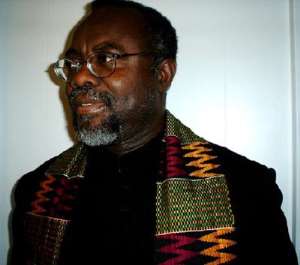
*Kwame Okoampa-Ahoofe, Jr., Ph.D., Associate Professor of English, Journalism and Creative Writing at Nassau Community College of the State University of New York, Garden City. He is the author of “Dr. J. B. Danquah: Architect of Modern Ghana” (iUniverse.com, 2005). E-mail: [email protected].

 One dead, fire officer hospitalised after bee attack at Quarry Site in Sokode Gb...
 Israel and Iran step back from further strikes after renewed clashes
 Patients stranded as doctors, nurses refuse to see new patients over KATH CEO su...
 Avenor Rural Bank CEO’s house destroyed by fire
 Three arrested in Winneba for illegal mining near GWL water lines
 Two pupils of Alice Elite Academy laid to rest after fatal school bus crash
 Here are areas to be affected by ECG's planned maintenance on Tuesday
 Family of civil engineer killed in alleged military shooting demands justice
 SHS teacher allegedly beats female student over unpaid hostel fees
 Blow to EU defence cooperation as France, Germany abandon joint fighter jet prog...



Comments
Blame Nkrumah for the "Volta Virus" how old were you when Kwame Nkrunah was the president of Ghana? Have you also care to read some of his writing? Mr writer. try and play your part for Ghana. Ghana need people who will help not the cry once.