




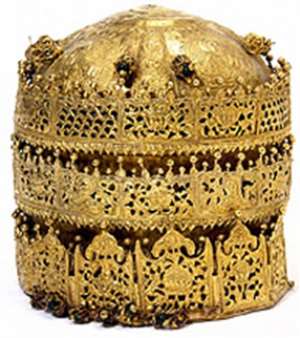
Crown of Tewodros II, Ethiopia, the Victoria and Albert Museum, London, United Kingdom. Looted during the invasion of Magdala in 1868 by a British Punitive Expedition army. The crown is labled at the Victoria and Albert as the "Crown of the Archbishop Abune Selam.” With typical colonialist and imperialist arrogance, this 18 karat gold crown was described as “barbaric” but still kept by the British.
According to a report in The Independent of 23 November, 2008, the Ethiopian President, Girma Wolde-Giorgis, has requested British museums holding stolen/looted Ethiopian cultural treasures to return them.
This is not surprising considering the enormous amount of Ethiopian cultural and historical objects that are in several British museums and universities. The real wonder is that these venerable institutions, including the universities of Cambridge, Edinburgh and others, have not found it necessary in all these years to return the objects which were not made for the British but for the Ethiopians. What kind of message are these learned institutions sending to their students and the rest of the world? They do not seem to be worried that by holding on to these stolen goods they are not only violating the proprietary rights of others but also their religious rights and their right to cultural development. How can they properly practice their religion when their religious objects and symbols are kept by others with whom they have no cultural affinities, thousands of miles away? We have not found an explanation for how those who consider themselves as Christians can steal the religious symbols and objects such as Christian crosses from other Christians? Where is their morality in holding on to stolen religious symbols and objects?
Countless UNESCO and United Nations resolutions urging the return of cultural artefacts to their countries of origin seem to have fallen on deaf ears. Are the actions of the British institutions not subject to the ordinary precepts of morality? If the professors and scholars do not see anything wrong with their actions or lack of actions, they should not be surprised that others adopt similar attitudes in other circumstances. Institutions of education and culture should contribute to better behaviour and not reinforce past criminal actions of earlier generations.
Ethiopians have been requesting for a long time the return of their cultural objects stolen in 1868 by an invading British Punitive Expedition army. All sorts of untenable and often insulting arguments have been advanced by British institutions. (Richard Pankhurst, “Maqdala and its Loot”, http://www.afromet.org Kwame Opoku,”Nefertiti, Idia and Other African Icons in European Museums: The Thin Edge of European Morality”, http://www.museum-security.org/)
We hope that the action of the Ethiopian President will be followed by other African Presidents in order to underline the importance of the issue of restitution of cultural objects to their peoples. Above all, a concerted action by African Presidents might bring momentum into the process of restitution. A certain amount of political pressure seems necessary for those holding on to looted cultural objects to react and do finally the right thing: return stolen cultural objects to their rightful owners.
 “Perhaps the most important Ethiopian loot is, however, stashed in the British Library, which holds some 400 Ethiopian manuscripts, many of them beautifully illustrated, dating from the 15th to the late 19th century.”. “Perhaps the most important Ethiopian loot is, however, stashed in the British Library, which holds some 400 Ethiopian manuscripts, many of them beautifully illustrated, dating from the 15th to the late 19th century.”. Richard Pankhurst, New African, November 2008, p.38. |

Ethiopian anklets, British Museum, London, United Kingdom.
Kwame Opoku, 5 December, 2008.
Ethiopia demands stolen crown back
By Andrew Johnson, Sunday, 23 November 2008 - The Independent
President writes to British museums to call for return of more than 400 treasures looted in 1868
Ethiopia is demanding that Britain's museums return some of its most significant religious treasures. President Girma Wolde-Giorgis has personally intervened in a dispute to get the artefacts, including the Ethiopian royal crown, returned home 140 years after they were “looted” by marauding British troops.
The President has written to the British Museum, the Victoria & Albert Museum, the British Library and Cambridge University Library seeking the restitution of more than 400 so-called “treasures of Magdala”, which were stolen by British soldiers following a battle in 1868.
In the letter, obtained by The Independent on Sunday, the President wrote: “I must state that Ethiopians have long grieved at the loss of this part of their national heritage. Ethiopians feel that this act of appropriation had no justification in international law. I feel, therefore, that the time has come for the return of Ethiopia's looted treasures.”
Among the items being held in the UK is an 18-carat gold crown and more than 300 priceless manuscripts, including Christian scriptures. Experts say the issue is particularly sensitive for Ethiopians because many of the artefacts hold deep religious significance for them. These include nine tabots, or sacred wooden altar slabs, which are recognised as so holy that the British Museum has pledged never to display them. When a tabot was returned in 2005 after being discovered in the back of an Edinburgh church, thousands of people turned out to greet its return in Addis Ababa.
The objects were among those seized by British soldiers after the storming of the Fortress of Magdala in 1868, a punitive expedition that followed the kidnap of several Britons. Emperor Tewodros committed suicide after the battle. According to contemporary accounts, British soldiers slaughtered hundreds of poorly armed Ethiopians after the battle, and then “jostled each other” to grab a piece of the emperor's blood-stained shirt, which they tore from his body. They also looted the citadel and a nearby church, carrying off treasures that included “an infinite variety of gold, and silver and brass crosses”, as well as “heaps of parchment royally illuminated”.
British museums have in the past resisted calls for artefacts from their collections to be returned to their countries of origin, but it is understood that Neil MacGregor of the British Museum and Mark Jones of the V&A have already met the Ethiopian ambassador to discuss the matter.
Museums often argue in restitution cases that the artefacts are better off in Britain because anyone in the world can view them, and the V&A is known to have asked Addis Ababa whether the silver crown of Emperor Tewodros, which it returned to Ethiopia in 1925, is available for public view.
The V&A said yesterday that discussions were still ongoing, even though the President's letter was sent in February this year. The four organisations involved have also held meetings over the way forward.
The Magdala treasure differs to other restitution cases, such as that of the Elgin Marbles, because it is acknowledged that the treasures were simply stolen. “It was straightforward looting,” a spokeswoman at the Ethiopian embassy in London said. A spokeswoman for Afromet, an organisation that has campaigned for the restitutions of the items, said: “These museums hold most of Ethiopia's heritage. It means far more to Ethiopians than it could ever do to anyone else.
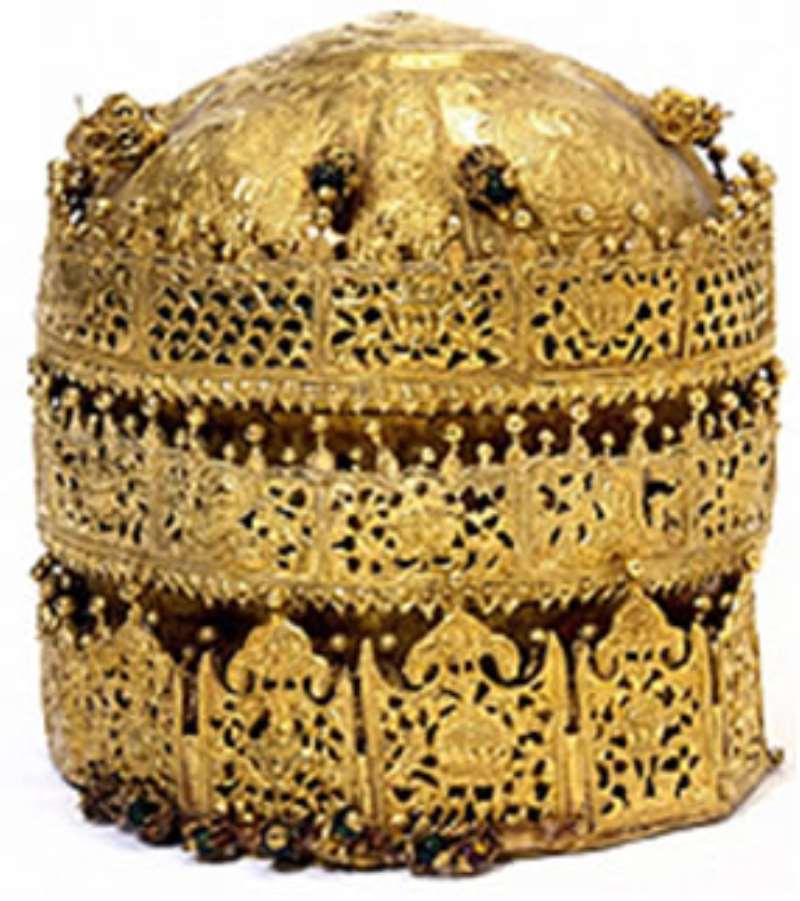 Crown of Tewodros II.
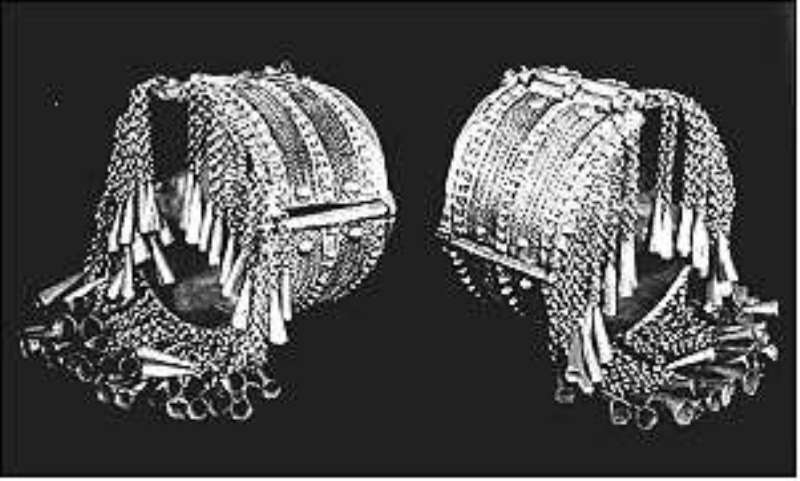 Ethiopian anklets, British Museum, London, United Kingdom.

 One dead, fire officer hospitalised after bee attack at Quarry Site in Sokode Gb...
 Israel and Iran step back from further strikes after renewed clashes
 Patients stranded as doctors, nurses refuse to see new patients over KATH CEO su...
 Avenor Rural Bank CEO’s house destroyed by fire
 Three arrested in Winneba for illegal mining near GWL water lines
 Two pupils of Alice Elite Academy laid to rest after fatal school bus crash
 Here are areas to be affected by ECG's planned maintenance on Tuesday
 Family of civil engineer killed in alleged military shooting demands justice
 SHS teacher allegedly beats female student over unpaid hostel fees
 Blow to EU defence cooperation as France, Germany abandon joint fighter jet prog...



Comments
Perhaps it is time to give what is Caesar to Caesar. As evevry eye is now open and Africa and the rest of the world do not see brtian as an Empire ready tio send its people to loot and bring back proceed . It is now abouit time they also do what is deemed cilvil to return all stolen or looted goods to rightful owners in the various countries instead of displaying it. If we do that what would have been the consequences for poor African then. Let's us think beyond the box.