




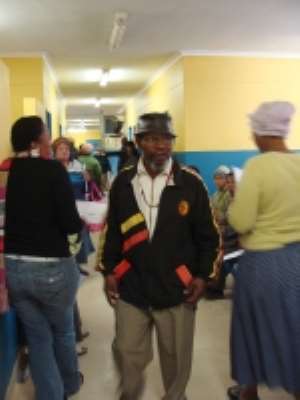
In the impoverished informal settlement of Du Noon, 20 kilometres north of Cape Town, sick residents rely on a single clinic staffed by six nurses to meet their health needs.
During one week in August, the nursing component of the clinic was reduced by 50 percent due to staff illness and training, forcing the clinic to turn away non-emergency patients from the 40,000-strong township.
"I am very upset because this is inconveniencing me. I have to go to work tomorrow and will have to ask a family member to take my daughter," said a mother who wanted routine immunization for her three month old daughter.
The mother, who did not want to be named, was one of many who became angry and started shouting at clinic staff, but long queues at public health centres are common in South Africa.
Visits to outpatient day hospitals across the city reveal waiting rooms packed to capacity each day as sick residents reliant on the state for health care wait to be seen to by a doctor or collect routine medication.
In a bid to try get obtain a consultation before the end of the day, residents arrive at the clinic as early as 5am.
Sitting in the waiting room at the day hospital in Khayelitsha -- the largest township in the Cape Town Metropole -- 58-year-old Oliver Lala said he arrived at the day hospital just after 5am in order to get medication for his asthma.
But after sitting on a "cold hard bench" all day without food, he only got to see a doctor at 4.00 pm -- 11 hours later - because his patient folder had been misplaced by the nurses.
"People can die here and nothing will be done, because we are nothing," he said.
One of the main reasons for these problems is a shortage of nurses, which are critical to the health care system as they are often the first to assist in a crisis, administer medication and provide comfort to patients.
According to information provided to Parliament in June by health minister Manto Tshabalala-Msimang, the shortage of nurses in South Africa is approaching 40,000.
Tshabalala-Msimang said there were 11,000 vacancies for professional nurses and nursing assistants in Kwazulu Natal alone and 8,419 vacancies in Gauteng.
While she did not provide figures for the Western Cape, the provincial health department says there is a shortage of 3,431 nursing posts in the province, with specialist categories such as intensive care units, theatres and mental health the hardest hit.
Mike Waters, health spokesperson for the opposition Democratic Alliance, said the nurse shortage was "shocking" and blamed the government for allowing the problem to escalate.
The amalgamation of nursing colleges around the country after 1994 reduced the capacity to train nurses. The situation was exacerbated when the mushrooming of fly-by-night operators of private nursing colleges led to a 2004 moratorium on the establishment of new training facilities.
Waters said the health department had delayed bringing out new regulations for public and private nursing colleges for nearly five years.
Meanwhile, while the direct consequences for patients are long waiting times and poor service levels, the shortage also comes with an economic cost.
Interning at Pietermaritzburg Hospital, Dr Lwazi Manzi said to lessen the burden of more people going to tertiary hospitals, patients were supposed to be treated at primary health care level first.
But Manzi said the state ended up having to spend more money on sick people at tertiary hospitals because of poor access to primary level care where illnesses could be "nipped in the bud".
She said the shortage led to a "vicious cycle" of under-staffing that placed strain on nurses and doctors.
Manzi said the shortage was "compromising the quality of health care" as it meant patients were not sufficiently monitored.
Several health professionals spoken to complained of poor pay. Democratic Nursing Organisation of South Africa (DENOSA) spokesperson Asanda Fongqo attributed the shortages to poor salaries, working conditions and safety and security.
According to DENOSA, professional nurses earn between $13,000 and $18,000 per annum depending on their level of expertise. This compares with salaries of between $22,500 to $45,000 that can be earned overseas.
Fongqo said there were a high number of cases where nurses were attacked by patients, who took out their frustrations on nurses.
Calling for the number of nursing colleges to be increased, he said nurses were working under "abnormal" workloads and were frustrated with the lack of equipment needed to carry out their work.
But the health department says it has developed a new occupational specific remuneration and career progression system for nurses in the public service, which was implemented in 2007.
Hennie Groenewald, director of workforce management in the national health department, argues that this has already shown a return of nurses to the public health sector, although acknowledges that the numbers are small.
Groenewald said the department had also drafted community service interns into the system, with 1,500 injected in 2008 and a further 500 expected later in the year.
In 2009, the department hopes to have more than 2,000 community service interns, but even if the majority of these take up full-time employment after the completion of their community service - as the department hopes - this is a relatively small number compared to the overall shortages of nearly 40,000.
Comment from our Legal Correspondent:
It is important for our ministers and others who are travelling to South Africa to take note of the information in the above article. The Ministry of Health in Ghana should take appropriate steps to improve our healthcare system. The facilities and equipment in South Africa may be of a better standard, compared to ours. However, without adequate staff, the consequences could be dire!!
By Yugendree Naidoo
 One dead, fire officer hospitalised after bee attack at Quarry Site in Sokode Gb...
 Israel and Iran step back from further strikes after renewed clashes
 Patients stranded as doctors, nurses refuse to see new patients over KATH CEO su...
 Avenor Rural Bank CEO’s house destroyed by fire
 Three arrested in Winneba for illegal mining near GWL water lines
 Two pupils of Alice Elite Academy laid to rest after fatal school bus crash
 Here are areas to be affected by ECG's planned maintenance on Tuesday
 Family of civil engineer killed in alleged military shooting demands justice
 SHS teacher allegedly beats female student over unpaid hostel fees
 Blow to EU defence cooperation as France, Germany abandon joint fighter jet prog...


