




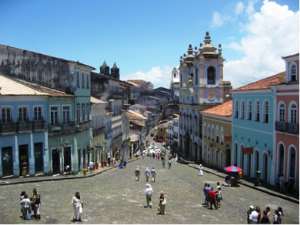
According to the report below, Nigeria has, with effect from last Friday, 30th September, 2008, a Cultural Centre, Nigeria Cultural House, Casa da Nigeria, in Salvador da Bahia, Brazil. This is a historical event which will surely not go unnoticed by all those interested in African History, the Transatlantic Slave Trade, and Afro-Brazilian Relations.
Situated in the historic centre of Salvador, Pelourinho, recognized as UNESCO World Heritage site because of the Portuguese colonial architecture, Nigeria Cultural House was opened by the Nigerian Minister of Tourism, Culture and National Orientation.
In his statement, the Minister, Prince Adetokumbo Kayode, reaffirmed the common ancestry and cultural affinity between the people of Bahia and Nigeria and expressed gratitude to the Government and people of Bahia for donating a property in the historical site in Salvador. The Minister also mentioned that the opening of the house offers an opportunity to “join hands together to fight racial prejudice in all its manifestations”.
As readers will know, after Nigeria, Brazil has the largest concentration of black people in the world and majority is in the State of Bahia, with its capital, Salvador da Bahia.
Readers will also recall that Salvador, the third largest city of Brazil, is also the most African of all Brazilian cities. The music, dance, religion, cuisine and the general culture of Brazilians have deep roots in African culture, especially in the Yoruba culture of Nigeria. The key elements of the Afro-Brazilian religion, the Orisas derive from the Yoruba culture and it is no accident that leading groups in Brazilian music, such as Olodum, Ilê Aiyè bear Yoruba names. Indeed, you can hear people in candomblé, the Afro-Brazilian religion, sing and pray in Yoruba. The main pillars of culture in Bahia, such as Pierre Verger, a Frenchman and devotee of candomble, spent his life in studying the religion of the Yoruba and its transplantation to Bahia. The famous artist, Carybé, made wooden panels of the orisas that are now in the Afro-Brazilian Museum in Salvador. Much food in Bahia, whether acarajé or vatapá, has its origin and flavour from Nigeria.
Given the cultural and historical links between Nigeria and Brazil, especially with Bahia, it is surprising that such a Cultural Centre was not opened soon after Independence in 1960. Even more surprising is to read that the house had been donated by Bahia to Nigeria as far back as 1998 but Nigeria had not made any use of the premises; it appears that the State of Bahia had threatened almost on a yearly basis to retrieve the building. Much seems to have gone wrong here.
Angola, Benin and South Africa have cultural centres in Salvador. When are the other African countries, especially those from the Atlantic coast, where the whole historical links between Africa and Brazil started, also going to mark their presence in Bahia?
We have no doubt that the opening of the Casa da Nigeria will contribute enormously to strengthening the bonds between Africa and Brazil to the benefit of both.
The Government of the State of Bahia and the Nigerian Government must be congratulated for this important historic step which was long in coming to fruition.
Kwame Opoku, 8 September, 2008.
DAILY TRUST
Nigeria commissions cultural house in Brazil
Written by Mohammed S. Shehu, on 31-08-2008 04:19
The Nigerian cultural and tourism industry took a giant step Friday in far away Brazil with the official commissioning of the Nigeria Cultural House in Salvador, Bahia State.
The house, located in Pelourinho, a UNESCO World Heritage site and the most populated black community in Brazil, is the first Nigerian cultural and tourism house outside the country.
Commissioning the house amidst cultural displays by the Nigerian National Troupe, the minister of Tourism, Culture and National Orientation, Prince Adetokumbo Kayode, said the house was a re-affirmation of Nigeria's commitment to strengthening tourism and cultural relationship with other countries, particularly those with similar historic and cultural backgrounds.
He expressed President Umaru Musa Yar´adua´s determination to make the house a gateway to attracting foreign tourists into Nigeria.
“It's gratifying to note that the opening of the Nigeria Cultural House in this historic city will bridge the international gap between both countries and avail Brazilians the opportunity to know more about our country. It avails us a unique window to join hands together to fight racial prejudice in all its ramifications. The Afro Brazilian cultural mix has bequeathed to Brazil a rich cultural mix that has earned her global acclaim,” the minister said.
He expressed optimism that the house would not only be a means of tourism and cultural exchange but a commercial venture to the two countries.
The governor of Bahia, Jaque Wagner, expressed gratitude to Nigeria for deeming it fit to have a cultural house in Bahia.
He said Bahia, with the highest black a population in Brazil, would utilize the architecture to boost cultural relationship with Nigeria.
“Being the most populated black nation on earth, Nigeria and Brazil have a lot of cultural potential in common with Bahia,” Wagner said.
He said the house would also provide residents and tourists the opportunity to revisit the past through the rich artifacts and other historic information on display in the house.
In his welcome address, the Nigerian Ambassador to Brazil, Mr Kayode Garrick, described the house as an important step to reach-out to the world.
He said Nigeria is now the third African country after the Republic of Benin and Angola to have a cultural house in Salvador.
Garrick said the house had affirmed the commitment of the government to forge ahead in deepening its close cultural relationship with Brazil especially in Bahia where he said significant percentage of its population traces its roots to Nigeria, particularly in Yoruba land.
Immediately the house was commissioned, tourists began to troop into the edifice to savour the many attractions on display by the National Council for Arts and Culture (NCAC), the National Commission for Museums and Monuments (NCMM) and the National Gallery of Arts.
The Brazilian government through the Bahia State and the Santa Casa de Misericordia da Bahia (SCMB), donated the house to Nigeria in 1998 for the purpose of facilitating cultural and social exchanges between the two nations.
But since it was donated, the edifice was abandoned and the donor country had on many occasions threatened to retrieve it.
Brazil has the largest population of blacks after Nigeria. Both countries also share common ancestral deities like Yomoja, Sango and Obatala. Nigeria's influence on black Brazilians tradition, religion, language, culinary science and music are indeed tremendous.
Daily Trust http://www.dailytrust.com

 One dead, fire officer hospitalised after bee attack at Quarry Site in Sokode Gb...
 Israel and Iran step back from further strikes after renewed clashes
 Patients stranded as doctors, nurses refuse to see new patients over KATH CEO su...
 Avenor Rural Bank CEO’s house destroyed by fire
 Three arrested in Winneba for illegal mining near GWL water lines
 Two pupils of Alice Elite Academy laid to rest after fatal school bus crash
 Here are areas to be affected by ECG's planned maintenance on Tuesday
 Family of civil engineer killed in alleged military shooting demands justice
 SHS teacher allegedly beats female student over unpaid hostel fees
 Blow to EU defence cooperation as France, Germany abandon joint fighter jet prog...



Comments
Kudos to this giant stride of the Federal Ministry of Tourism Culture &N ational Orientation and the Nigerian government. May the international mission of foreign Centers be achieved continuosly through this Cultural Centre. Above all, may Nigeria and the Ministry of the Culture Ministry (FMTC&NO) continue to open more Cultural Centers to showcase our rich cultural heritage and the unique cultural diversities of Nigeria. This Cultural Center and many more will help in fulfiling Nigeria' goal of...