




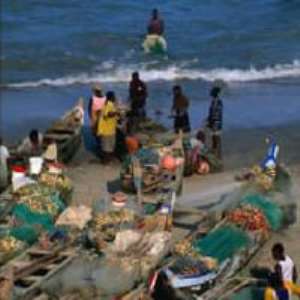
The Daily Graphic's report of a poor annual fish harvest this season and the paper's subsequent interviews with key players in the industry on the problem of the so-called pair trawling, as one of the leading causes of the depletion of fish stocks in Ghana's waters, is an example of good development journalism from an investigative perspective.
The Fisheries Ministry has rightly argued that dwindling fish harvests are a global problem induced by environmental, climatic and economic factors.
The Daily Graphic last Saturday quoted Dr Francis Nunoo of the University of Ghana Department of Oceanography and Fisheries as attributing the dwindling fish harvests partly to Ghanaians' craving for the popular “Keta School Boys (fingerlings).
Fingerlings or 'baby fish' are a necessary fisheries regenerative resource as they are food for larger fish and should not be eaten by fish consumers on the present scale, the marine scientist explained.
To worsen matters, the scientist indicated, local fishermen were also engaged in bad fishing practices.
Poor sanitation and environmental practices in coastal areas were further compounding the problem of decreasing fish harvests.
While these arguments are valid, they ignore or at least seem to downplay the importance of the argument raised by local canoe fishermen and marine environmentalists about the very efficient but also very destructive impact of modern fishing technologies being used by foreign fishing companies in our waters:
While Dr Nunoo may be right in attributing declining catches partly to bad fishing practices employed by local fishermen, many fishermen and fisheries researchers have blamed the problem of bad fishing practices on the depletion of fish stock by large foreign trawlers in the first place.
According to one tropical fisheries study, “decreased fish catches (in West Africa) have resulted in increasing poverty of fisher folk and local fishermen have therefore resorted to the use of larger nets, and mesh sizes less than one inch, to harvest juveniles (Keta school boys).
They also use explosives and chemicals to be able to catch a lot of fish.”
Last week, Graphic reporter Rose Hayford Darko and cameramen Sam Adano went to the beach in Tema and spent some time with fishermen seated in their boats.
Like the fishermen Jesus would later recruit to his ministry, they had returned from sea without a catch.
Unlike Jesus's friends, the local fishermen had “launched out into the deep and let down the nets”, without a catch.
Simultaneously, reporters Kofi Yeboah and Moses Aklorbortu spoke to fishermen along the coasts of Accra, Axim and Takoradi.
Almost to a man, the fishermen agreed that the depletion of fish stocks by foreign trawlers was responsible for the fast declining catches and this year's poor harvest.
The evidence that pair trawling is one of the main causes, if not the leading cause, of our dwindling fish stocks, is overwhelming:
In a recent report on fishing along the West African coast, the global environment group Green Peace states bluntly that “European trawlers are scooping up the lion's share of West Africa's fish stocks leaving them severely depleted.”
Apart from the obvious consequences on the nutritional status and economic status of coastal communities and West African nations, the situation poses a danger to the lives and safety of traditional fishermen in West Africa:
Green Peace says the situation is compelling local fisherman to venture out farther out to sea in motorized canoes.
“Now traditional fishermen are forced to sail their small open canoes farther out to sea in search of a decent catch.
Intended only as inshore craft, the canoes are being sailed up to 200 miles offshore, where they are very vulnerable in the open ocean.
The fishermen lack safety equipment such as lifejackets and face the risk of marine accidents all for a catch sometimes consisting mainly of low-grade fish” the environmental group reported.
The increasing dangers traditional fishermen face far out at sea sometimes take the form of foreign trawlers running over or ramming into fishing canoes.
The BBC reported the case of a Gambian fisherman and small boat owner, Papa Khan, whose small boat was “smashed in two one night by an illegal trawler, killing ten of his crew, including his brother.
Khan who survived the accident, told the BBC that "when the trawlers are stealing our fish they turn off their lights. We didn't see it until it was so close.
We couldn't avoid it.” Green Peace paints the following mental picture along the coast of Senegal to symbolise the situation along the coast of West Africa today:
“On a beach in the West African State of Senegal, a traditional fishing canoe is dwarfed by the rusting hulk of a giant European trawler.
It's a stark image which sums up the unequal battle that Senegal's fishing communities face - against the elements, against the big industrial fishing vessels and against the might of the European Union.”
According to marine environmentalist Kary Fulton who has investigated the problem of dwindling fish stocks along the coast of Ghana and other West African countries, fishing in the sub-region's waters used to be done in a sustainable manner by small boats and local fishermen.
“It was labour intensive and employed most of the men in the coastal communities. Today the Japanese, Koreans, Russians, Chinese, Taiwanese and European nations use their large boats equipped with modern equipment.”
Fulton says the technologies used by fishing fleets in Europe have left many northern nations severely depleted fish stocks and these nations which are looking for new areas to fish, are targeting the coasts of Mauritania, Sierra Leone, Guinea, Liberia, the Ivory Coast and Ghana.
Thus, foreign vessels are not only in competition with one another in West African waters but also with local fishermen. Some marine environmentalists have likened pair trawling and the use of large trawl nets in general to the indiscriminate clearing of forests.
A recent BBC report on the problem warned that “West African governments have to balance their need for foreign exchange earnings with the need to safeguard fish stocks, not only for the future but also to help feed their own people today.”
It said fish stocks along the Senegalese coast for example are already in such a crisis that “the government has taken to tossing old cars and even decommissioned tanks into the sea, in a desperate bid to create artificial reefs to attract fish back.”

 One dead, fire officer hospitalised after bee attack at Quarry Site in Sokode Gb...
 Israel and Iran step back from further strikes after renewed clashes
 Patients stranded as doctors, nurses refuse to see new patients over KATH CEO su...
 Avenor Rural Bank CEO’s house destroyed by fire
 Three arrested in Winneba for illegal mining near GWL water lines
 Two pupils of Alice Elite Academy laid to rest after fatal school bus crash
 Here are areas to be affected by ECG's planned maintenance on Tuesday
 Family of civil engineer killed in alleged military shooting demands justice
 SHS teacher allegedly beats female student over unpaid hostel fees
 Blow to EU defence cooperation as France, Germany abandon joint fighter jet prog...


