




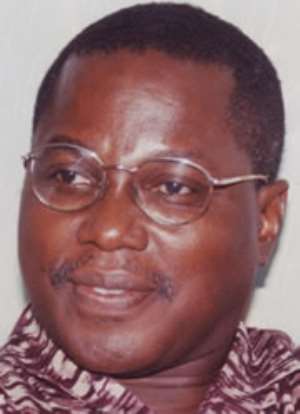
Nii Moi Thompson, the University of Ghana development economist, stands (sometimes with group of like-minded folks) against the ruling National Patriotic Party regime attempts to sell to Vodafone Plc of the UK 70.0 per cent state-owned Ghana Telecom (GT) attest to the increasing growth of Ghana's democracy.
For the past years, Thompson has being flowering with Ghana's budding democracy and has become one of the products of Ghana's democratic conscience in a country where for sometime the long years of heavy military and one party regimes created in its wake profound crisis of intellectual unfreedom against the background of traditional Ghanaian humanistic debate, learning and philosophy.
In Thompson, Ghanaian democracy is coming to terms with the Indian Nobel Prize-winning laureate Amatya Sen reasoning that development necessitates the unblocking of foremost sources of unfreedom – “poverty as well as tyranny, poor economic opportunities as well as systematic social deprivation, neglect public facilities as well as intolerance or overactivity of repressive states.”
Further to such freedoms in development, Thompson's ability to appropriate Ghana's democratic freedoms to further open up the development process reminds me of Alexander Solzhenitsyn, the Russian Nobel laureate, more especially in his great work The Gulag Archipelago. For Solzhenitsyn, it is not merely to be free but that freedom should have an aim and it has to be critical aim. In the context of Thompson, Ghana's democratic freedom necessitates wise choices and noblest aspirations and that means in the context of Ghanaian values and progress, it matters what Ghana choose in its overall development process.
Thompson's crusades against the GT sales aren't only from his personal conviction that has been fertilized by Ghana's democracy, but sometimes partnering with other like-minded. On August 1, Thompson and five other folks, more from the Convention Peoples Party (CPP), instituted a civil action against the ruling NPP over its planned sale of GT to Vodafone. Thompson and his associates are asking the court to revoke the deal and dissolve the newly created 'Enlarged Ghana Telecom' and that the agreement is without due process. More seriously, as Thompson reveals in his economic nationalism, is his group calling for the restoration of the fibre optic network to the state-owned Volta River Authority that had managed such ventures well before.
Thompson's grumble with the attempted GT sales borders more with economic nationalism as well as accountability and financial prudence. In Thompson, democracy has given the Ghanaian the platform to dissect the society deeply and join in how the development process should be directed against the backdrop of its elites who are perceived not to think well, especially from within Ghanaian cultural values, as the Southeast Asians have done. Still, in Thompson we see the new social democratic CPP (that has metamorphosised from its earlier Marxist-Leninist ranting) that had in its years of rule under first President Kwame Nkrumah been economically inefficient, politically destabilizing and imperially expensive re-tooling itself – CPP was undemocratic.
Restless, articulate and with good grasp of Ghana, democratic gadfly Thompson reveal the new debate for an “African Way,” where African cultural values are mixed with the global prosperity ones for progress. Last year, Thompson saw the Ghana Investment Promotion Centre (that's supposed to help develop 90 percent of indigenous industries) sick and advocated for its restructuring “with a greater focus on the development of the micro and small scale sectors to better complement Government's efforts at achieving middle income status.”
Like the Ghana Telecom campaigns, Thompson isn't saying privatization or globalization or the private enterprise isn't good (as some may think of him as a socialist), what he is saying is that such ventures should flow from Ghanaian/African values, history and experiences in relation to the global progress so as to give good sense, deal and confidence to the Ghanaian development process. No doubt, Thompson has asserted to the Accra-based The Statesman that “the informal economy, which employs about 85 percent of the total workforce in Ghana, contributes only 40 percent of Gross Domestic Products, while the formal sector, with 15 percent employment rate, generates 60 percent of GDP.” “This imbalance,” Thompson said, “cannot prepare the private sector to accelerate the growth of the economy.”
The GT row increasingly tells the deepening of the Ghanaian democracy and Thompson radiates it. In the GT debate Thompson tells Ghana that Ghanaians have to care what they choose in their progress and not caring what is chosen for development is corrupting of Ghanaian development virtues.

 One dead, fire officer hospitalised after bee attack at Quarry Site in Sokode Gb...
 Israel and Iran step back from further strikes after renewed clashes
 Patients stranded as doctors, nurses refuse to see new patients over KATH CEO su...
 Avenor Rural Bank CEO’s house destroyed by fire
 Three arrested in Winneba for illegal mining near GWL water lines
 Two pupils of Alice Elite Academy laid to rest after fatal school bus crash
 Here are areas to be affected by ECG's planned maintenance on Tuesday
 Family of civil engineer killed in alleged military shooting demands justice
 SHS teacher allegedly beats female student over unpaid hostel fees
 Blow to EU defence cooperation as France, Germany abandon joint fighter jet prog...


