




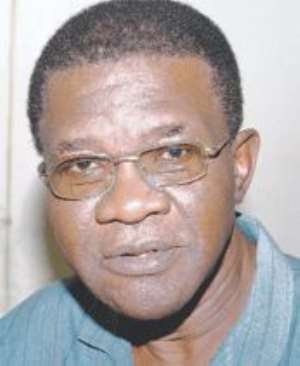
The first Director-General of Ghana Telecom, Mr Ebo Aggrey-Mensah, has predicted that the sale of 70 per cent shares of Ghana Telecom (GT) could spell the economic doom of Ghana.
He said with the dwindling natural resources and the prospects of telecommunications providing economic boom and prosperity, it would be suicidal for the country to sell the 70 per cent shares of GT for any amount.
Mr Aggrey-Mensah called at the offices of the Daily Graphic to present what he called the “reasons why 70 per cent of GT should not be sold”.
He attributed the current woes of GT to the adoption of bad policies that had been inimical to the growth of GT; loss of revenue from the sale of 30 per cent shares of GT in 1996; loss of large sums of revenue as a result of interconnection regime; the abrogation of the Telekom Malaysia contract; and incomplete valuation of GT.
He mentioned some of the effects of the sale as national security concerns; loss of revenue to the state; loss of national pride and loss of opportunity to develop the critical human resource assets of the nation, and suggested ways to save GT without selling it.
He said Ghana should emulate the examples of other nations that had developed and never hesitate to restrict the importation of products when the prevailing exigencies demanded, adding that GT should not be sold just to balance the national budget.
Mr Aggrey-Mensah, who was also the last Director-General of Ghana Posts and Telecommunications Corporation, suggested that the National Communications Authority (NCA) could review all the existing agreements with the other competitor telecommunication service operators and adopt measures that would strengthen GT, so that in the final analysis Ghanaians and not foreigners would be the beneficiaries.
He further explained that the country had relied on the export of its natural resources — gold, cocoa, timber, diamond, manganese — and very soon on the new found oil, but all these would be exhausted with time.
“In such a situation the only source of foreign exchange that could salvage the economy would be the proceeds from the telecommunications sector, which has the potential to expand by leaps and bounds.
The fantastic story of MTN is there for all to see,” he added.
He said with this in mind the nation must look for the needed resources to properly equip and strengthen GT to make it competitive and be able to provide the much needed foreign exchange for the socio-economic development of the country in future.
Mr Aggrey-Mensah added that the woes of GT worsened when as part of the liberalisation process of the telecommunications sector GT was made as the incumbent national telecommunication services operator to provide inter-connection circuits between itself and the new mobile cellular service operators to enable the origination of calls from one network to the other.
In the process, he said, GT lost colossal sums of revenue as a direct consequence of the inter-connection regime.
He added that with the long delay in granting licence to operate cellular phone — which is faster to deploy and has lower maintenance cost unlike the land-line services that require digging of trenches, laying of cables, mounting of distribution poles and associated problems such as cable theft, destruction of cables by drivers among others — GT was made the loser.
Mr Aggrey-Mensah argued that while Mobitel, now Tigo, was granted licence in 1992 to provide cellular services, it was not until 2000, when Spacefon, now MTN, and Celltel, now Kasapa, had also been granted licences that the national telecommunication service, GT, was granted licence to provide cellular service.
According to him, another reason for GT's current woes was that although the NDC government advertised and sold 30 per cent of its shares to the Malaysians with the claim that the proceeds would be invested in GT, “not a single cent of the $38 million that was realised from the sale went to GT. Where that money went was anybody's guess”.
Mr Aggrey-Mensah said when Telekom Malaysia's agreement was abrogated, it was the poor GT, which did not benefit from the sale, that was made to pay the $52.2 million as settlement fee.
The former MD expressed surprise that those who valued GT failed to place a value on the critical human resource of the company; “therefore, it follows logically that it will be inappropriate to base any firm decision to sell any portion of the shares of GT on the results of a valuation process which is both incomplete and flawed”.
Regarding national security, he argued that in the light of the continuous development of more modern and highly sophisticated security technologies, it would be impossible to guard against national security breaches when such a national telecommunication facility was in the hands of foreign investors.
“For the foregoing reasons, the Ghanaian staff of GT should not be denied the opportunity to also learn to effectively manage the affairs of GT, with the active support of majority shareholders,” he added.
Story by Donald Ato Dapatem
 Former MASLOC CEO Sedina Tamakloe returns to Ghana after extradition to serve 10...
 Tension in Birim North as angry NDC youth attempt to disrupt cooperative mining ...
 One dead, several injured in tipper truck and fuel tanker crash on Accra–Tema Mo...
 How 70-year-old building was finally demolished over fear of collapse in Osu
 Minority MPs thank Afenyo-Markin for capacity-building programme in Canada
 Ghana has everything needed to prosper yet graduates remain unemployed — Dr Step...
 June 9: Cedi sells at GHS12.50 on forex market, GHS11.85 on BoG interbank
 Stephen Amoah advocates mixed market economy to tackle rising cost of living in ...
 KMA to reintroduce enhanced ‘Samansaman’ sanitation enforcement system from July...
 Nyinahin Catholic SHS teacher seen fighting female student in viral video arrest...



Comments
It is rediculous for someone like you to think the sale of GT to Vodafone could spell the economic doom of Ghana. The analysis from Mr. Aggrey-Mensah is definitely not appropriate at this time. As the Minister of Finance said, anybody who has a better solution for the GT should present it. Just talking about national pride and things like that do not help GT. I personally believe that there is no management instutition in Ghana that can provide any remedy to the problems of the GT. I am not surp...