




“And I am left thinking that the "Enlightenment principles on which public museums in the United States were established" have perhaps contributed to the irreversible destruction of our universal, or cosmopolitan, cultural heritage”.
David Gill, Collecting Antiquities and Enlightenment Principles (1)
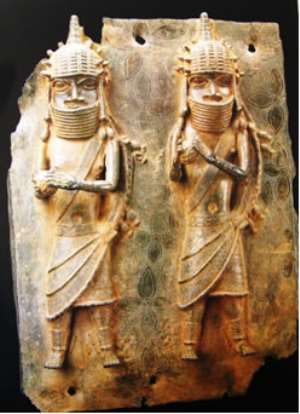
…The exhibition, Benin: Kings and Rituals Court Arts from Nigeria, goes to the Art Institute of Chicago (A.I.C.) from July 10 - September 21, 2008 as the final station of this travelling exhibition which, starting in Vienna, generated debates about restitution of stolen art, went to Paris and Berlin. It is to be noted that the exhibition which is the biggest ever held on Benin art will not be seen in Nigeria. It goes next to Chicago. But what kind of institution is the Art Institute of Chicago?
The Art Institute of Chicago was established in 1879 as the Chicago Academy of Fine Arts and changed to its present name in 1882. The museum is well-known for its collection of European Impressionist art works and American art. Although the museum has some excellent African art works, it is not famous/infamous for its African collection. It has some Benin objects too but not on the same scale as the British Museum, London, and the Ethnology Museum, Berlin. Indeed, interest in African art has surprisingly not always been very strong in a museum in a city with a large African-American population that has a long history of subjection to the most incredible racial segregation and discrimination. Interest in African art in the museum has reflected interest in Africa, largely due to political changes and improvement in race relations.
According to Kathleen Berzock's excellent study, “African Art at the Art Institute of Chicago” African art objects used to be in the Children's Museum: “The Children's Museum was the only place African art could be found at the Art Institute before the 1950s when a department devoted to the arts of Africa, Oceania and the Americas was developed”. (2)
The Children's Museum was aimed at the education of children and had drawings, posters, illustrated books and dolls. Water colour, wood and ivory carvings were also available to introduce children to artistic techniques. A large variety of dolls were also available in the museum. “The Negro in Art Week”, devoted to African-American art, was also held at the Children's Museum in 1927. The placement of African art in the Children's Museum was not accidental:
“While the very presence of African art in the Art Institute suggested interest in the works' aesthetic dimensions, its sole placement in the Children's Museum implied that it was not considered to be equal in merit or significance to art on view in the main galleries. This was not the case with works from the United States, Europe and Japan, which were exhibited in both locations. The underlying supposition was that African art appealed to less mature sensibilities and, further, that the work of its artists was comparable to that of children. Thus, while admitted into the Art Institute's hallowed halls, African art was expected to be kept in its separate and unequal place, an attitude which continued well into the 1940s. Despite such sentiments, interest in African and other so-called primitive art was growing among the Western Modernist avant-garde.” (3)
When a Benin plaque was acquired by the museum in 1933, the person responsible for African art at the museum stated that the acquisition “brings to our attention the amazing discoveries of the year 1897, when for the first time the technical skill and achievements of this now decadent civilization were brought before the civilized world”. (4)
In 1957, the museum created a Department of Primitive Art which was responsible for the permanent art collections of African, Oceanic and Amerindian Art. In 1980, the Department of Primitive Art was changed into Department of Africa, Oceania and the Americas and in 1995 the department was renamed the Department of African and Amerindian Art. (5)
The various designations of the department to deal with African art are indicative, to some extent, of the changing attitudes to African art and social and racial relations. These changes tell an interesting story when one recalls that in talking about Africa, the Art Institute of Chicago leaves out, like Hegel and others, an important African country: Egypt. Egypt comes under the purview of the Department of Egyptian Art. In the 60's, 70's and 90's notable exhibitions were held at the Art Institute: “Traditional Arts of Africa's New Nations” (1961), “African Textiles and Decorative Arts” (1972), “Dogon Art from the Lester Wunderman Collection” (1975), “Gold of Africa” (1991), and “Baule: African Art/Western Eyes”(1998)
The history of African art in the Art Institute of Chicago demonstrates that African art has not been displayed or treated in the same way as art from other continents. Where then is the support for the argument of the “universalists” that there is a great advantage in having arts from cultures of the whole world under one roof? All cultures under one roof but with African culture in the Children's Museum on the assumption that Africans will never develop beyond the ability and intelligence of the average Euro-American child? Does this really help children to understand and appreciate other cultures?
What makes the Art Institute of Chicago very important, in the context of restitution, is less the objects found therein than the attitude of its present director, James Cuno. (6)
James Cuno, Director, Art Institute of Chicago, Chicago, Philippe de Montebello, Director, Metropolitan Museum of Art, New York, and Neil MacGregor, Director, British Museum, London constitute a triumvirate which defends the so-called “universal museums.” Cuno is undoubtedly the most outspoken and vociferous spokesman for the supporters of the so-called “universal museums” and has written articles and books in support of their stand. (7)
He makes the most provocative and outrageous statements to defend the retention of stolen cultural objects found in the large museums, mostly acquired during the colonial period and in many ways as a direct result of the use of massive violence against countries in Africa, Asia, the Americas and Oceania.
The most formal document of this group of museums is the infamous Declaration on the Value and Importance of the Universal Museums (2002) signed by 18 of the biggest museums in the world. (8)
It should be noted that the British Museum which instigated the whole joint effort in order to counterbalance the political pressure exerted by Greece because of the Parthenon Marbles, cunningly did not sign the declaration. Simply and briefly stated, these large museums have declared that they have no intention of restoring objects forcibly removed or stolen, to their countries of origin, despite several United Nations and UNESCO resolutions. (9)
In the Foreword to the catalogue to the Benin Exhibition, four co-operating museums, Musée du Quai Branly, Paris, Ethnology Museum, Vienna, State Museums in Berlin, and the Art Institute of Chicago, have stated clearly they have no intention of returning any stolen objects, including the Benin bronzes and have advised Benin/Nigeria and the African countries to forget the past and to look ahead to the future. (10)
As part of his strategy to defend objects that are present illegally in Western museums, Cuno has rejected the idea that States have any ownership in archaeological objects found on their soil:
“Anthony Appiah said something wonderful in his book Cosmopolitanism. He says, Look we don't know who made these Nok sculptures, these ancient sculptures that are found today in Nigeria. We don't know if they were made for royalty or for one's ancestors or on speculation. But what we know for sure is that they weren't made for Nigeria. Because at the time there was no Nigeria.” (11)
Cuno has gone so far as to deny that there is any connection between ancient Egyptian civilization and present day Egypt or between ancient China and present-day Peoples Republic of China.
“It is a stretch of the imagination to link modern Egypt to ancient Egypt, modern Greece to ancient Greece, modern Rome to ancient Rome, and communist China to ancient China. Nonetheless, countries like Italy, Greece, Turkey, China, and many others have laws that make any antiquity found on their soil automatically the property of the state.“ (12)
"The people of modern-day Cairo do not speak the language of the ancient Egyptians, do not practice their religion, do not make their art, wear their dress, eat their food or play their music. All that can be said is that they occupy the same (actually less) stretch of the earth's geography”. (13)
Cuno also makes UNESCO responsible for destruction of cultural property: “In a 2006 essay in the New York Review of Books, the philosopher and Princeton professor Kwame Anthony Appiah argued that such laws have even destroyed antiquities. Soon after the Taliban took over Afghanistan in 1996, Appiah pointed out, it was a UNESCO treaty prohibiting the removal of antiquities from their country of origin that prevented concerned scholars from rescuing pre-Islamic artifacts before the Taliban, branding them idolatrous objects, destroyed them.”(14)
Such an absurd accusation should normally not deserve any comment but it comes from the director of one of the major museums in the Western world which claim to represent all cultures in their museums. He does not seem to be aware that UNESCO does not make the policies of States and that the Convention on the Means of Prohibiting and Preventing the Illicit Import, Export and Transfer of Ownership of Cultural Property (1970) was in no way responsible for the policy of the government in the case he mentions. What can be said about that particular issue was that the Convention would not authorize a group of Western States or scholars to dispose of a cultural object the way they deem fit against the will of a government determined to pursue a policy of destruction, however deplorable that might be.
That the outrageous and provocative statements of Cuno are not simple slips of the tongue or of the pen is demonstrated by the statements in his forthcoming book in which he expresses similar views. Tom Flynn has correctly declared, after reviewing an excerpt from the forthcoming book:
“The UNESCO Convention has not failed. But no amount of international conventions and agreements can overcome the obstacle represented by bellicose developed economies imposing their will on weaker nations, which has become a signal factor in the rise of cultural heritage desecration.
Mr. Cuno, like many leading museum directors, is currently suffering from post-colonial tristesse — that melancholy condition which descends with the realisation that the great universal museum collections over which they preside are no longer able to maintain the upward growth curve that began during the imperial era. Get over it.
We must now look forward to a more equitable distribution of material culture. It is the American neoliberal psyche that needs to move beyond its "pervasive misunderstanding, even intolerance of other cultures."
A proper understanding of that sense which Mr. Cuno refers to, that "ancient and living cultures belong to all of us," will only really set in when European and North American museum directors cease believing in their eternal and divinely-endowed role as custodians of global cultural heritage.” (15)
It is evident that the attempts by Cuno, MacGregor, Philippe de Montebello and others to present their hardly veiled nationalist and imperialist views as “universalist” have woefully failed. Nobody, outside their small group of self-sufficient and self-assured museum directors and officials will support them in their attempts to justify a historic perspective which is now recognized by most people to have been a disaster for the world and definitely incompatible with democracy as understood these days. You cannot preach democracy to Zimbabwe today and try to justify British imperialism of the 19th Century. Cuno regards as “nationalist” attempts to recover stolen objects but does not seem to think that those keeping illegally acquired property are also “nationalist” in their motivation? Would he perhaps agree that they are imperialist in their motivation? They are fighting for the greater glory of the USA, Great Britain and France and their arguments are no different from those of the imperialists of the 19th Century. They see the world only from the perspective of London, Paris and New York and cannot believe that people in Accra, Bamako, Dakar, Koforidua, Mombasa or Zaria, see things differently. It has rightly been said that Cuno's position smacks of “colonialism”. I would add “and imperialism”:
“The question smacks of arrogance and even, some might say, colonialism,'' says Chapurukha Kusimba, the Field Museum's associate curator of anthropology. "When this book is finally released, there's going to be a huge uproar. It's going to portray the Art Institute in a very bad light." (16)
Cuno, like many of those who wish to retain stolen/illegally exported cultural objects in Western museums, distorts the argument of those fighting for restitution to imply that they do not want objects of their culture to be seen outside the countries of origin or by others. He declares:
“One can also imagine cases when it makes sense for an antiquity to be with similar artifacts from different cultures: Han Chinese ceramics with Roman and Mayan ceramics in London, and Greek classical bronzes with Han bronzes and even much later Benin and Italian Renaissance bronzes in New York. Why should we want to see an antiquity only within the country of its presumed origin? Why does it have its greatest meaning there? Why shouldn't we want to see the art and antiquities of China, for example, also in New Delhi, Athens, Rome, or Mexico City (or London or Chicago, for that matter) with examples of comparable cultural artifacts from India, Greece, Rome, and Mesoamerica?“ (17)
Cuno knows very well that nobody has ever objected to anybody seeing Han Chinese ceramics with Roman and Mayan ceramics in London and Greek classical bronzes with Han bronzes and Benin and Italian Renaissance bronzes in New York. What many of us have argued is that peoples of the countries where these objects were produced should not be deprived from also seeing the objects of their culture. The people of Benin should not have to travel to Chicago, London, Berlin to see the best Benin bronzes. Africans should not have to travel to Europe or to the U.S.A. to see the best African art. Is this difficult to understand? When one looks at Cuno's argument, it becomes clear that he, like his friends, Neil MacGregor, Director, British Museum and Philippe de Montebello, Director Mertropolitan Museum of Art, who is praising the book even before it has been published, that they look at the world only from the vantage points of Chicago, New York and London. Even in arguments against supporters of restitution, most of his examples are based on the needs for the museum visitors in New York and London. The Western world is the only one that matters to the supporters of the “universal museum.” Whilst we would want to see more Benin objects returned to Benin, he seems to think more should be sent to New York.
Incidentally, these “universal museums” that are loud about art objects being part of the heritage of mankind and insisting that there should be no restrictions or control on the flow of art objects from the so-called “source countries” forget the concept of world heritage and charge other museums for loans of cultural objects; they demand exorbitant fees for loaning their masterpieces to other museums. The Louvre is even charging the planned museum in Abu Dhabi $520 million for the right to use Louvre's name. So much for the heritage of mankind. How many African countries could afford to borrow any work of art from the “universal museums”? The concept of heritage of mankind only seems to work when the USA and UK need to defend possession of cultural objects from the rest of the world or to increase their already excessive acquisitions. We are still waiting to hear them argue for the need to send some Goyas, Picassos, Manets, and Monets etc to Abuja, Bamako, Dakar or Luanda.
How is co-operation possible between African countries and a museum such as the Art Institute of Chicago? African museums and institutions that cooperate with institutions that follow this line of thought must make it abundantly clear to all that their limited and specific cooperation or participation should not be misconstrued as endorsement or condoning of these outrageous and illegal positions. They owe it to themselves and their people not to be seen as selling away their cultural objects and rights. But how long can they hold on to such a position when others delight in making abrasive pronouncements?
One can expect the powerful Nigerian community in Chicago and Illinois to make its presence felt during the exhibition and its voice heard on the question of restitution. (18) It does not however seem there will be any debates or discussions on restitution such as was done in Vienna. There will be a Royal Gala celebrating the Exhibition. “Honored guests at A Royal Gala will include representatives from the Court of Benin and the Nigerian Commission on Museums and Monuments.” Those wishing to participate are required to pay $200 (two hundred US dollars). There are, of course, rich Africans and Nigerians in Chicago and the United States. But I wonder how many of the Africans there can afford this sum. According to the announcement, the proceeds from the gala are to be used in supporting development exchange between the Art Institute of Chicago and Nigerian cultural institutions.
It has not been announced whether there will be any other events accompanying the exhibition in Chicago. Hopefully, arrangements will be made for the African guests to meet the leaders and representatives of the sizeable Nigerian and African communities as well as the bigger African-American population in Chicago. They would learn a little more about the universal values practised in Chicago over the centuries. They would surely be informed about developments in the Southside of Chicago and the image of Africa and the situation of African-American culture over the years.
The Exhibition has unintentionally rekindled the restitution debate and has for the first time since the1897 aggression against Benin assembled many of the objects which had been spread in the world, especially in Europe and in the U.S.A. demonstrating that Benin was a great civilization that could have become even greater had the British not brutally attacked the kingdom and stopped its development. One of the alleged pretexts for the aggression, that Benin was a city of blood could only be accepted or supported by those who had already accepted the imperialist project. Nobody would have accepted as an excuse for invading, looting and burning Chicago on the ground that it was a city of gangsters. The allegation of bloodthirstiness seems to be beloved by Europeans bent on taking control of African countries. A similar allegation was made by the British against Asante in 1874 when the real reason was the unwillingness of the Asante to allow the British to control trade on the coast of the Gold Coast.
What will happen to the Benin bronzes and the large number of stolen African art objects lying in European and American museums, mainly in depots? We know now that the Europeans and Americans have no valid reason for keeping theses objects. They do not need them and do not use them. Will they return at least some of them? Will the future generations of Africans be more aggressive and demanding than their predecessors? Will they continue to trust the Europeans and Americans in such matters, contrary to the historical experience of some 500 years? Most likely, there will be changes, perhaps sooner than later if the outrageous views of Cuno, MacGregor and de Montebello are seen to represent the official views of the Europeans and the Americans. Fortunately, there are other more reasonable views even in the Western World:
“The problem of what to do with foreign collections from the era of
European colonialism is coming to the fore; repatriation demands from the countries of origin have emerged as one of the challenges of globalization. The ongoing attempts to repackage and re-present these collections in response, by no means limited to ethnographic material, deserve the attention of anthropologists as 'cosmologies in the making'. Such revised 'cosmologies' are, as we shall see, inseparable from the social configurations of power in nation-states currently challenged by globalizing forces, and they obviously are not static. The British Museum's 'world cultures', Rotterdam's recreated Wereld museum, the Parisian 'arts premiers' extravaganza at the new Quai Branly Museum and others all involve the contestation, modification and sometimes the abandonment of older guiding categories like 'fine art', 'ethnography' etc. In my view, the repackaging of collections across the West (including in the self-declared bastions of Western modernity in the US) represents realignment with globalizing forces which could potentially yield a new beginning and a new one-world spirit, privileging global responsibility over national or private ownership. But any such 'cosmopolitanism' might also easily be co-opted by the 'free trade' antiquities industry, with its museum allies and associated 'globalized' power elites scrambling to fend off the increasingly intense scrutiny from regions still being looted to fill these museums today.” Magnus Fiskesjö, (19)
Kwame Opoku, 14 May, 2008.

 One dead, fire officer hospitalised after bee attack at Quarry Site in Sokode Gb...
 Israel and Iran step back from further strikes after renewed clashes
 Patients stranded as doctors, nurses refuse to see new patients over KATH CEO su...
 Avenor Rural Bank CEO’s house destroyed by fire
 Three arrested in Winneba for illegal mining near GWL water lines
 Two pupils of Alice Elite Academy laid to rest after fatal school bus crash
 Here are areas to be affected by ECG's planned maintenance on Tuesday
 Family of civil engineer killed in alleged military shooting demands justice
 SHS teacher allegedly beats female student over unpaid hostel fees
 Blow to EU defence cooperation as France, Germany abandon joint fighter jet prog...



Comments
I(L)PIE(L)