




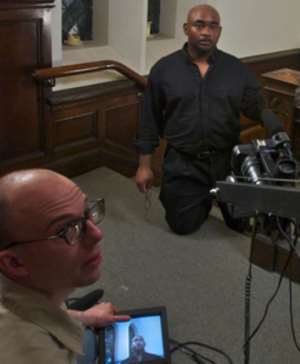
Immigrants are shooting stories that contribute to the breathtakingly prolific West African film industry.
By Matt Blanchard
For The Inquirer
While Philadelphia celebrates most any piece of Hollywood glamour it can get, few have noticed another globally important movie industry making inroads here.
It's not Hollywood, nor is it India's Bollywood, but rather Nollywood - the freewheeling and wildly prolific West African cinema nicknamed for its base in Nigeria.
With annual sales estimated at more than $200 million, Nollywood is the world's third-largest film industry, and may be home to some of its fastest filmmakers. According to the Nigerian Film and Video Censors Board, Nollywood churned out 1,687 films in 2005 alone - many shot on a shoestring budget, edited and released in just 10 days.
The movies, many of them soap operas with plots revolving around religion and family, love and betrayal, are available in the United States in African-owned video stores, hair-braiding salons and eateries, and such sites as nollywoodmoviesonline.com.
Now Philadelphia's African immigrants aren't just importing Nollywood hits, they're making them, with two locally shot films released this summer and two more on the way.
Once Upon a Lie, the second film by a mixed African and American team, premieres July 18 at Southwest Philadelphia's ACANA community center. It's a suspenseful blend of Nollywood's two major preoccupations, melodrama and the supernatural, transported to Southwest Philly's Woodland Avenue, the heart of the city's African community.
On the set last month, actor Mustapha Saccoh, a.k.a. "Daddy Muss," explained his part in the complex plot. He plays a sharply dressed, diabolical seducer named P-Jack who steals the wife of an honest African immigrant with the help of a magic charm concealed in a potted palm. The poor husband sends home to Africa for a second wife, but struggles with his own extramarital temptations, while the local pastor, tormented by visions, tries to counter P-Jack's malign influence.
Saccoh, a 44-year-old reggae musician from Sierra Leone who sings about love and positive values, says he's a little nervous about playing a libidinous villain like P-Jack. But the theme of adultery resonates down at 65th and Woodland.
"There are guys just like him who come here and don't want to work," says Saccoh, who lives in Southwest Philadelphia. "They dress real nice and behave like Casanovas so the women will take care of them."
The film's supernatural aspects - the clairvoyant priest, the magic love charm - reflect the mix of Christian and traditional myth in West African film (for a more outlandish example, check YouTube for a trailer for The Stolen Bible).
"The film has aspects of social realism," explains the American director Michael Wellenreiter of Severine Pictures, "but at the same time, there's an apocalyptic conflagration to end the film."
Wellenreiter and cinematographer Adam Carrigan are known for their music videos for two of Philly's biggest indie bands, Man Man and The Teeth. For them, a major appeal of West African cinema is simply that it's nothing like American independent film.
"It's a way of escaping all the indie cliches," Carrigan says. "You know, the personality quirks, and the family issues, and the whole kitsch aesthetic. . . . This is the opposite of all that."
The team behind a second Philly Nollywood film, Imported Bride, operates from the back room of an African video store at 66th and Woodland. Unable to afford a professional cameraman, producer Sekou Kamara, a native Liberian, says his team bought two $4,000 Panasonic digital cameras, mastered Adobe editing software, and watched countless YouTube clips to learn filmmaking.
"YouTube is our university," Kamara joked. He spent years in refugee camps in Ghana before arriving here in 2000.
Imported Bride, too, tracks immigrant family anxieties, following an older man who sends to Africa for a wife, only to see her run up huge cell phone bills and take up with a flashy younger man.
"When the woman comes here, she wants to realize her own dreams," says the movie's male lead, Mamulu Henry. "African men have to realize this is the land of opportunity, not only for men, but for everybody."
Getting his traditional-minded actors to play the romantic scenes took a lot of coaxing, Kamara says, but having released the film in mid-June, he's already editing Imported Bride 2. As fans know, every Nollywood film has a sequel.
Each Imported Bride cost less than $15,000 to make and will be distributed not to theaters but on DVD to African-owned video stores. After burning 5,000 copies, Kamara will take a road trip to major African communities in New York, Rhode Island, Maryland and Minnesota, where the films sell for $5 to $10.
DVD pirating is inevitable, Kamara says, and almost welcome: "It's the only way our movie will be able to go everywhere."
The straight-to-DVD model was set in Nigeria during the 1990s, when the violent reign of military dictator Sani Abacha made many in the capital, Lagos, afraid to venture to traditional movie theaters after dark. A vigorous DVD trade grew up in the city's Idumota electronics market, and the suburb of Surulere became a sort of Studio City.
What's known as the New Nigerian Cinema, still in its teens, already has superstars like Stephanie Okereke and Ramsey Nouah, and major directors like Chico Ejiro, nicknamed "Mr. Prolific," with more than 100 films to his credit. And Nollywood has its own scandals, too, as when the release of a sex video last year forced one Nigerian starlet to go into hiding.
"It's not the kind of story we're used to hearing out of Africa," says Jamie Meltzer, director of the 2007 documentary Welcome to Nollywood. "Usually Africans are seen as victims, or as victimizers. Nollywood is about people who created their own film industry out of nothing. And now it's the third largest in the world."
The major Nollywood genre is melodrama, Meltzer says, along with dramatizations of current affairs. A period of historical epics has come and gone, as has a vogue for occult themes. Since the industry is still so young - the Hollywood equivalent would be 1905 - Meltzer says it may be that the "true Nollywood film" has yet to be created.
In Philadelphia, cast and crew of Nollywood-style films tend to be Liberian or Sierra Leonean, many of them refugees from brutal civil wars in both nations.
Harris Korboi Murphy, producer of both Once Upon a Lie and the moody 2006 immigration drama Legalization, survived Liberia's first civil war (1989-1996) and escaped to the United States at the start of its second (1999- 2003). His grandfather, an uncle and many of his friends were not so lucky.
With Liberia now at peace, Murphy is sending his Philly Nollywood back to Africa - Legalization sold well in Liberian video stores and played small venues in Sierra Leone.
Murphy also has huge dreams for Liberian cinema: First, an atrocity epic called Plantation Massacre, based on the true story of a retired U.S. Marine's efforts to free dozens of child hostages. "It will be bigger than Blood Diamond"! he insists on a call from Los Angeles, where he's trying to sell the script. He says he's also working on a deal to acquire 2,000 acres outside the capital, Monrovia, to build a Liberian Hollywood.
"We want to bring people in from all Africa for equipment training, for actors, directors of photography and make-up," Murphy said. "It will be like the major studios here, like Paramount Pictures, so that films made in Africa can compare to films made in the Europe and the U.S."
Until that day, Philadelphia remains Murphy's Nollywood backlot. Next month he begins a third film, as yet unnamed, in which two immigrant women battle for the love of a rich lawyer, one armed with voodoo magic, and the other with the power of Christian prayer. It's a classic Nollywood project, except that scenes of the West African outback will be shot in Fairmount Park.
 Nyinahin Catholic SHS teacher seen fighting female student in viral video arrest...
 Beijing condemns US move to blacklist Chinese companies
 Trump gets a cold reception at NBA Finals game as Spurs beat Knicks
 One dead, fire officer hospitalised after bee attack at Quarry Site in Sokode Gb...
 Israel and Iran step back from further strikes after renewed clashes
 Patients stranded as doctors, nurses refuse to see new patients over KATH CEO su...
 Avenor Rural Bank CEO’s house destroyed by fire
 Here are areas to be affected by ECG's planned maintenance on Tuesday
 SHS teacher allegedly beats female student over unpaid hostel fees
 Blow to EU defence cooperation as France, Germany abandon joint fighter jet prog...


